Association of Computer Science Students (ACSS) — UC (PnC)
President
2024 – Present
Public Relations Officer
2023 – 2024

 HTML5
 CSS3
 JavaScript
 React
 Next.js
 Astro
 Tailwind CSS
 Java
 Python
 PHP
 TypeScript
 Node.js
 MySQL
 Firebase
 Supabase
 JSON
 Vercel
 Render
 Git
 GitHub
 Docker
 Figma
 Canva
 Codex
 Claude
2024 – Present
2023 – 2024
2026 – Present
2025
2026 – Present
2024
2025 – Present
2026 – Present
2026 – Present
2023 – 2024
2025 – Present
2024 – 2025
2026
2025
2024 – 2025
2024
Our bachelor’s thesis: an offline multi-agent system for Java refactoring within 4 GB of VRAM. HorizonAI coordinates planning, code generation, and validation through specialized small language models, evaluated on 279 Java tasks to examine memory efficiency and refactoring reliability.
Our entry submitted for the Philippine Startup Challenge 10: a community platform concept connecting veterinary clinics, rescue groups, and animal-care supporters. Its landing page introduces the vision, outlines planned features, and gathers early interest through role-based registration and a public roadmap.
A client landing-page project for Anytime Fitness, built with React, TypeScript, and Tailwind CSS. The page brings club discovery, membership information, and coaching into one experience, with a preview available while official utilization is still pending.
An arcade-style digital literacy toolkit for Grades 4–6 learners, developed as part of PROJECT XP, the 2025 SIBOL ng Laguna Kaunlarang Teknolohikal champion initiative. Still under development, it brings learning games, facilitator resources, and community documentation into one platform.
Our second-year OOP final project: a Java Swing learning management system for students, instructors, and administrators. NovaLearn connects courses, learning content, notifications, and performance tracking through object-oriented design, using Singleton, Factory, and Observer patterns with in-memory object lists.
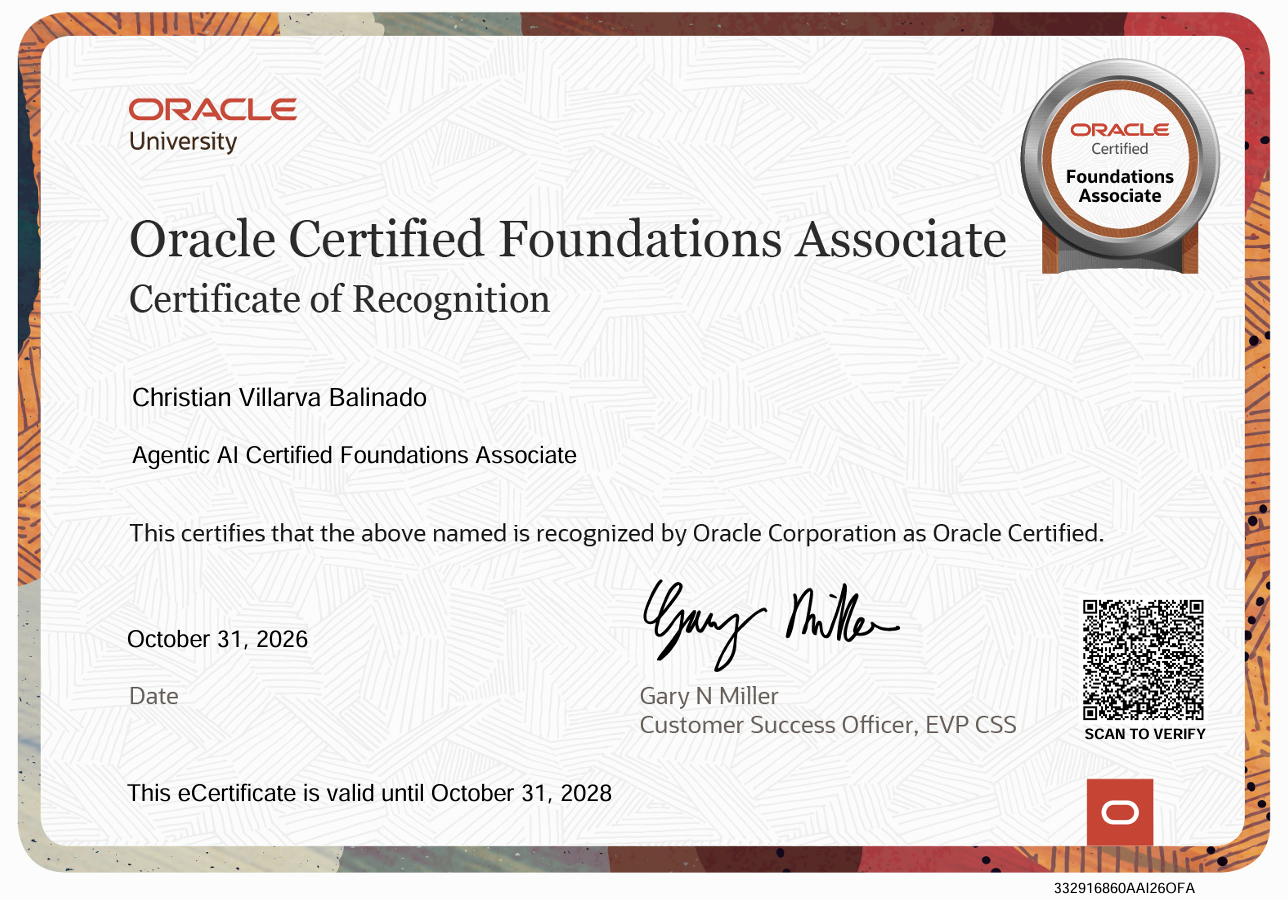
Oracle / 10.31.2026
I earned Oracle’s foundations certification in agentic AI, covering agent architecture, reasoning, tool use, multi-agent workflows, and safety guardrails. This strengthens my technical understanding of AI systems and gives me a clearer basis for discussing their behavior, limitations, and validation needs.
Google / 10.29.2026
I earned Google’s Gemini Certified Student credential, covering effective prompting, response evaluation, and responsible AI use for learning and productivity. It strengthened my approach to AI-assisted work: reviewing generated outputs critically and using these tools thoughtfully when researching, communicating, and organizing tasks.

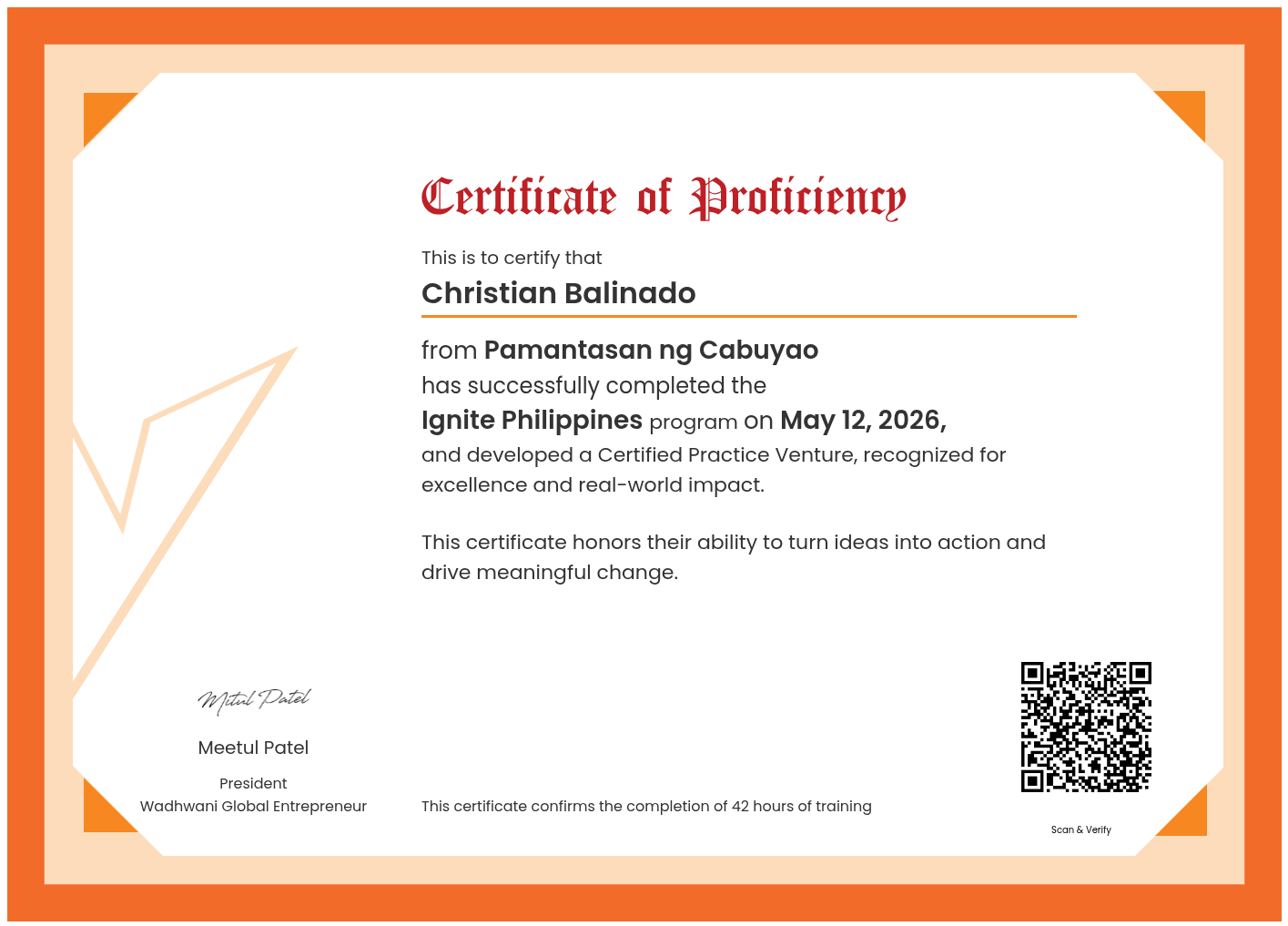
Wadhwani Foundation / 05.12.2026
I completed 42 hours of entrepreneurship training and developed a Certified Practice Venture through Wadhwani Foundation’s Ignite Philippines program. The experience strengthened my problem discovery, idea validation, prototyping, and pitching skills, helping me connect technical project decisions with user needs and practical delivery.
I'm always interested in meaningful software projects, open-source initiatives, and collaborative ventures. Let's connect and build something impactful together.
PROJECT / 01
Thesis / AI Refactoring
Our bachelor’s thesis: an offline multi-agent system for Java refactoring within 4 GB of VRAM. HorizonAI coordinates planning, code generation, and validation through specialized small language models, evaluated on 279 Java tasks to examine memory efficiency and refactoring reliability.
Make controlled, offline Java refactoring accessible on a consumer laptop with only 4 GB of VRAM. Our Bachelor of Science in Computer Science thesis at the University of Cabuyao investigated whether specialized small language models could coordinate within that limit, with explicit validation at every handoff.
Larger language models demand computing resources many schools and developers lack. A single model also handles every reasoning step, allowing an early error to propagate into generated code. HorizonAI investigates horizontal intelligence: a planner, generator, and judge coordinated through memory scheduling and validation.
Using Java refactoring as its application domain, the study compared HorizonAI with a larger single model on 279 tasks and gathered feedback from 25 end users and 10 IT experts. The architecture met the 4 GB VRAM constraint and resolved 78.5% of tasks. It used 20.1% less peak memory and produced slightly simpler code, but took about five times longer. Its compilation and behavior-preservation rates reached 86% and 88% of the baseline rates, respectively.
The contribution is a measured tradeoff: coordinated small models can support controlled local refactoring under a strict hardware ceiling. The results establish lower memory use and offline accessibility, without claiming higher accuracy than the larger baseline.
Vertical model scaling raises hardware and energy requirements. For institutions without high-end GPUs, local execution becomes impractical, while cloud inference introduces recurring costs and sends code outside the local environment.
Reliability is a separate challenge. Probabilistic code generation can introduce defects or unnecessary complexity, and a reasoning error can cascade through a monolithic workflow. The study addresses the limited empirical evidence for structured, fully offline multi-agent refactoring under severe hardware constraints.
Conducted at the University of Cabuyao from January to October 2026, the work deliberately reflects resource limitations faced by nearby institutions such as St. Vincent College of Cabuyao and Westbridge Institute of Technology, Inc.
The Orchestrator governs stage transitions and commands the Agent Service through SSIS. The Agent Service loads and executes quantized models sequentially. Sharing the Planner and Generator weights reduces model swaps while preserving separate responsibilities.
The Validator applies syntax and structural checks before the Judge reviews the result. These deterministic gates and model-based revision requests form the D2NR correction loops; neither replaces a formal proof of behavioral correctness.
The Context Manager stores session state, reasoning logs, and agent handoffs in local SQLite so information survives model unloading. The Connection Manager links the offline backend with the Glassbox web interface for real-time monitoring.
The repository implements a Python/FastAPI backend with llama-cpp-python and a Next.js/TypeScript frontend. WebSocket updates connect the interface to the local pipeline; Docker distribution supports local installation. Repository capabilities may evolve beyond the evaluated thesis configuration.
The execution environment was an Intel Core i5 laptop with 16 GB RAM and an NVIDIA RTX 2050 with 4 GB VRAM. All evaluated models used 4-bit quantization. A Qwen2.5-Coder-7B-Instruct model provided the larger single-model baseline.
The benchmark used 279 Java tasks from the Code Polish subset of CodeEditorBench. Compilation Success Rate measured whether generated code compiled; Behavioral Equivalence Rate measured preservation of original behavior. Local inference time and peak GPU memory captured the hardware cost, alongside code-complexity observations.
Twenty-five purposively sampled computing students and faculty evaluated interaction capability, functional suitability, security, and reliability. Ten IT experts assessed functional suitability, performance efficiency, reliability, and maintainability using the ISO/IEC 25010:2023 product quality framework.
HorizonAI stayed within the 4 GB VRAM limit and resolved 78.5% of the selected tasks. Peak memory use was 20.1% lower than the larger single-model baseline, and the resulting code was slightly simpler.
Execution took approximately five times as long. Compilation success reached 86% of the baseline’s compilation rate, while behavior preservation reached 88% of the baseline’s behavior-preservation rate. These are relative comparisons, not absolute success percentages or percentage-point differences.
End users rated the system highly acceptable, and technical experts rated all four assessed quality characteristics favorably. The evaluation covered interaction capability, functional suitability, security, reliability, performance efficiency, and maintainability across the two participant groups.
The evaluated workflow processes text and isolated Java snippets. It does not cover complex multi-file repositories, multimodal input, model fine-tuning, or distributed deployment. Unsupported transformations, including Extract Class, fall outside the implemented benchmark coverage.
Inference runs fully offline once the required software and quantized weights are available locally. Reasoning capacity is bounded by those local weights. Sequential execution conserves memory but increases latency and limits responsiveness.
Syntax parsing and structural routing detect specific failures; they cannot mathematically guarantee alignment with developer intent or perfect behavior preservation. Findings are limited to the selected tasks, purposive survey samples, quantized models, and tested laptop configuration.
The screenshots document the local interface, including guided-tour examples and an individual session’s metrics. They are interface illustrations, not aggregate benchmark evidence.
For AI researchers and system designers, SSIS and D2NR provide documented patterns for memory-constrained orchestration, bounded retries, and recovery. Future work can investigate other languages, tasks, models, or hardware limits.
For software engineering practitioners, the visible stages and validation gates support inspection before integration. Philippine development teams and MSMEs can use the findings to assess offline deployment, proprietary-code privacy, hardware affordability, and recurring API costs.
For academic institutions, the tested consumer laptop provides a concrete reference for teaching multi-agent coordination without a specialized AI laboratory. Applicability depends on comparable hardware and workload rather than a universal performance guarantee.
Overall project direction, team coordination, and oversight of thesis deliverables.
Technical implementation across the frontend and backend, including integration of the refactoring workflow.
Implementation of the Glassbox web interface and its user-facing refactoring views.
Quality assurance coordination, testing oversight, and verification of system behavior against project requirements.
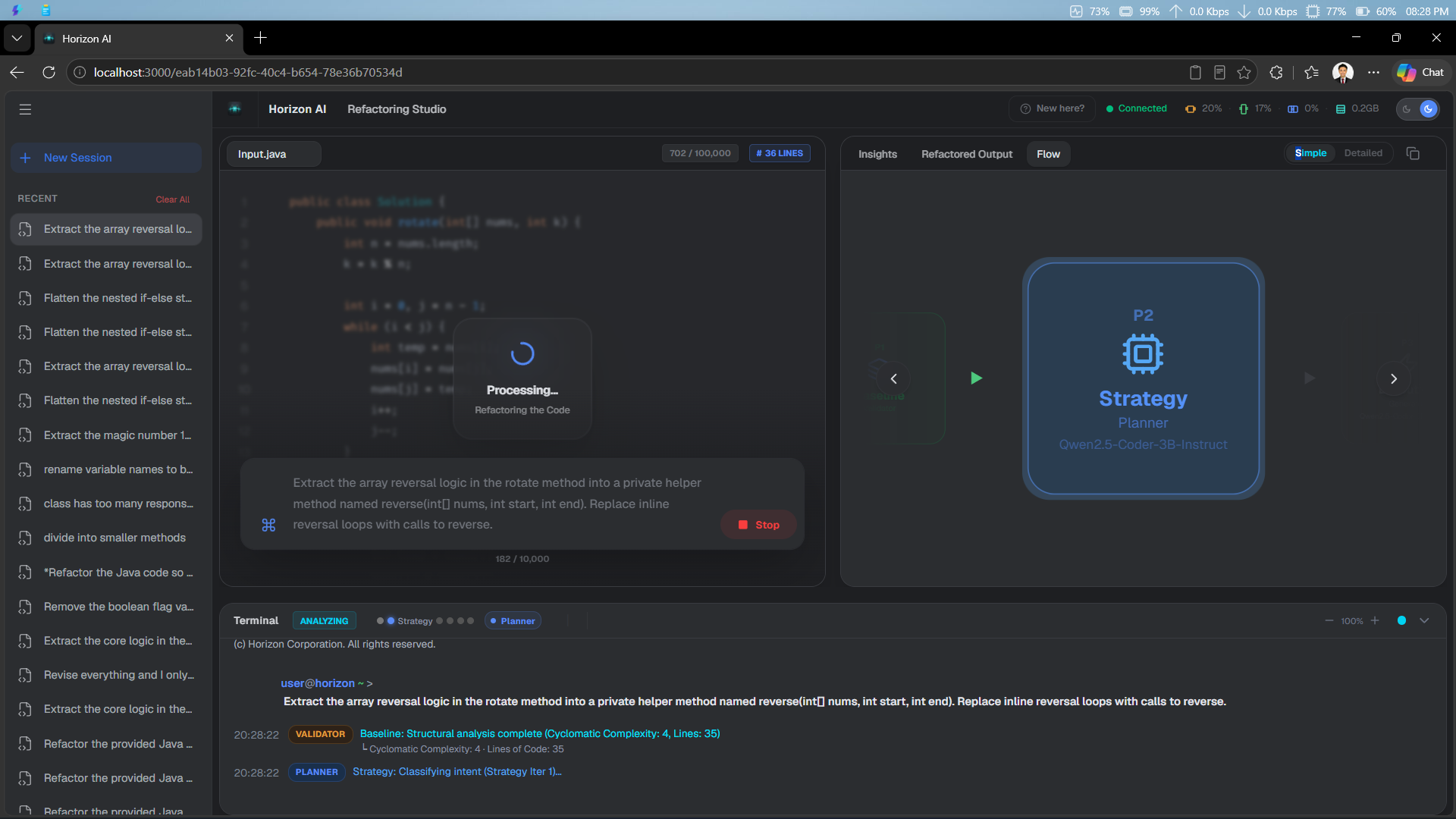
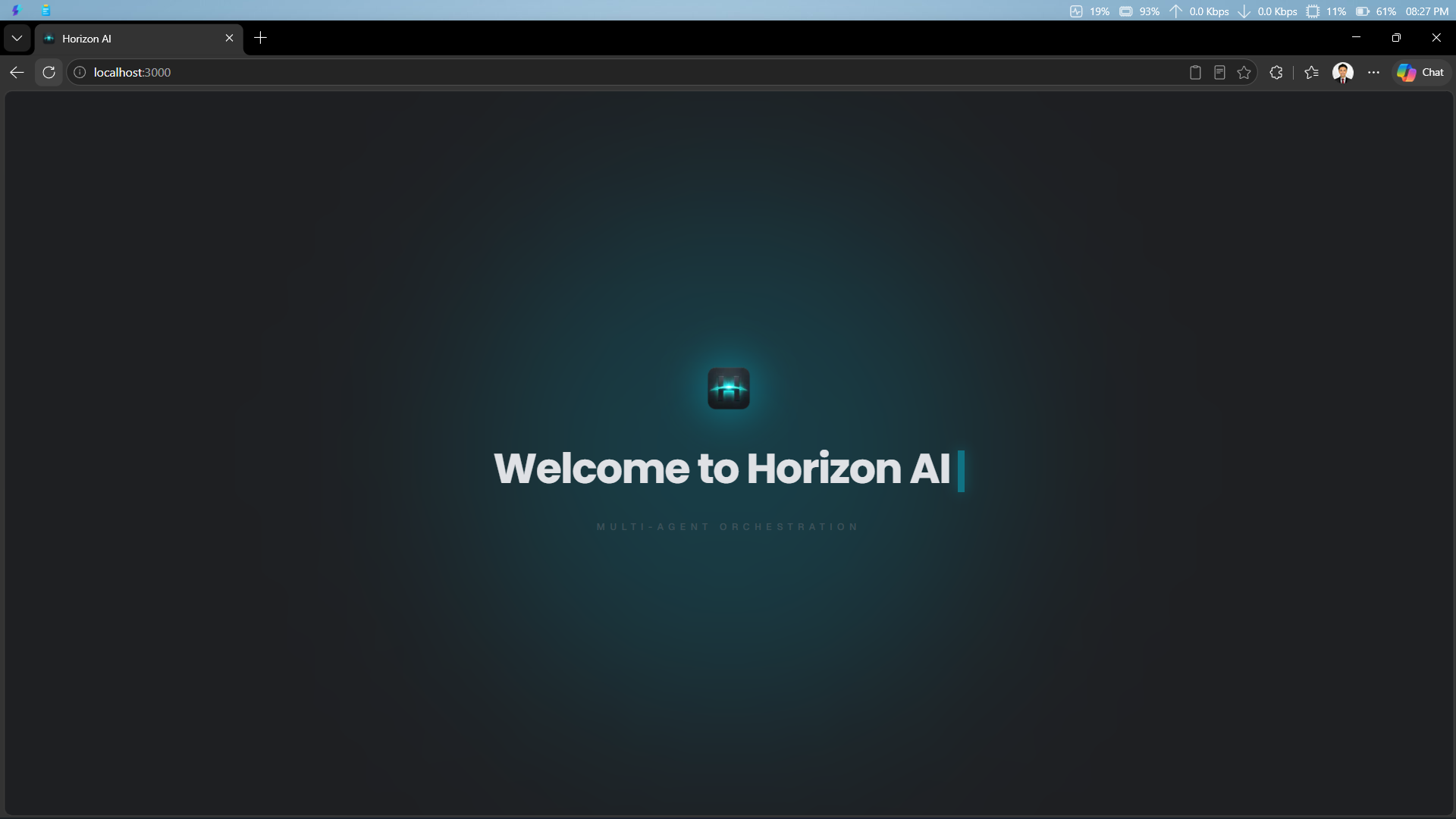
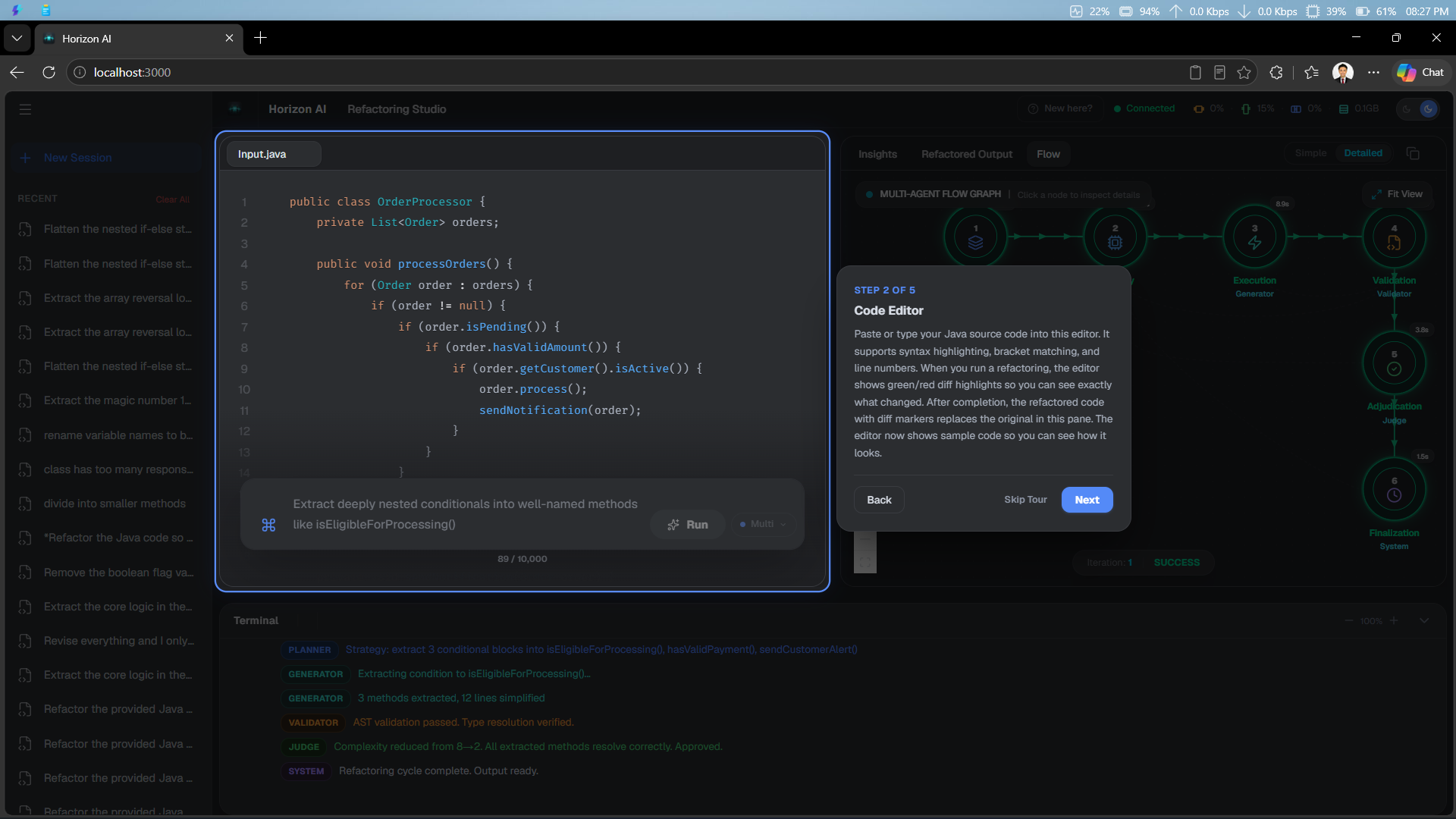
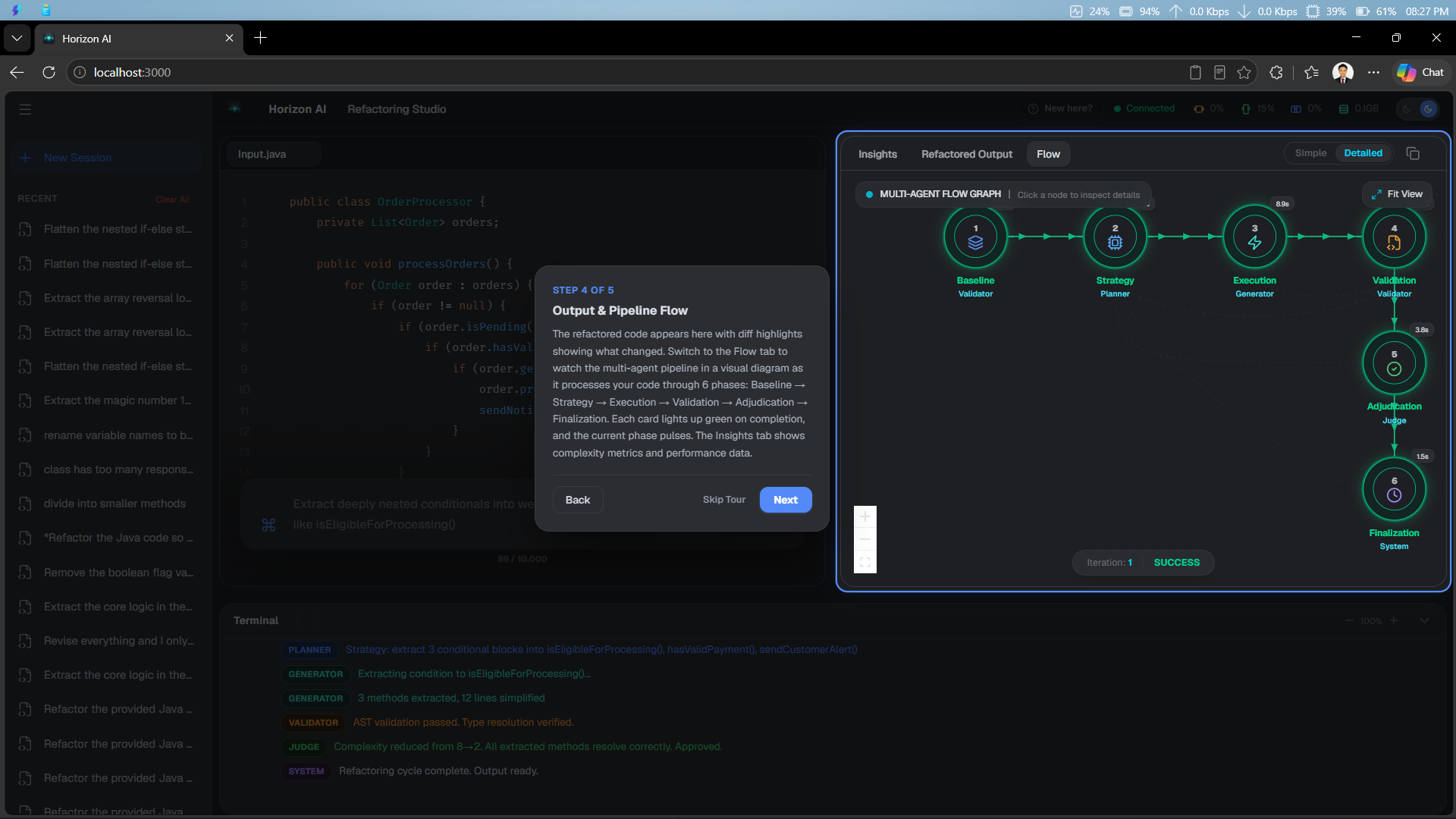
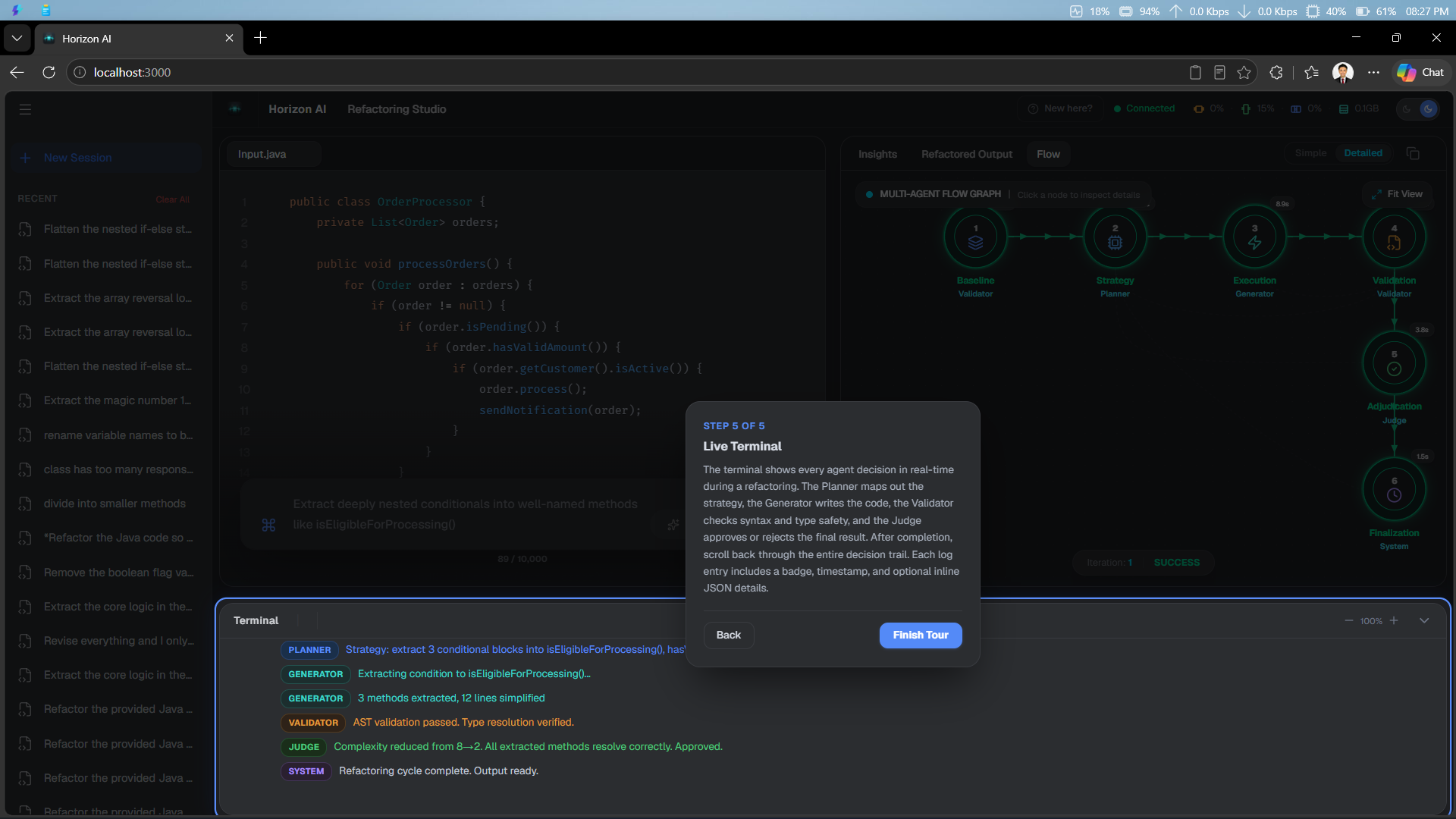
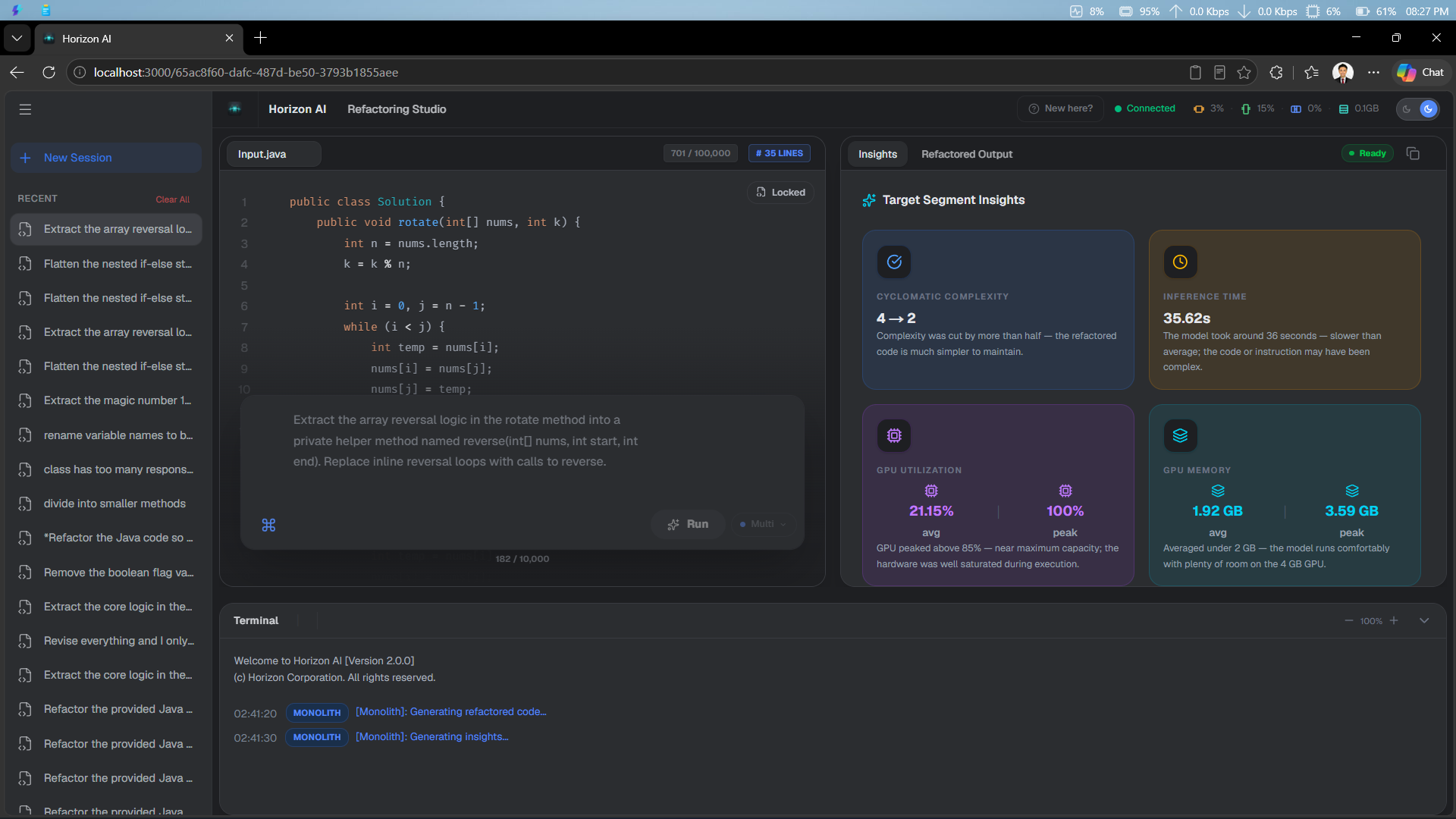
A locally deployed, role-driven Java refactoring system and an empirical evaluation of its memory, runtime, correctness, and software quality. The thesis demonstrates feasibility on modest hardware while documenting the cost in speed and accuracy. The public landing page introduces the project; refactoring runs in the separately installed local application.
PROJECT / 02
Startup Entry / Landing Page
Our entry submitted for the Philippine Startup Challenge 10: a community platform concept connecting veterinary clinics, rescue groups, and animal-care supporters. Its landing page introduces the vision, outlines planned features, and gathers early interest through role-based registration and a public roadmap.
Introduce Animora, our Philippine Startup Challenge 10 entry, through a focused pre-launch landing page. The concept connects veterinary providers, rescue groups, and animal-care supporters in the Philippines. The page gives visitors a clear introduction to that vision and a way to express early interest before the wider platform is built.
The outline describes a fragmented animal-care ecosystem: pet owners need accessible care, rescue groups need support and visibility, and veterinary providers need ways to connect with their communities. The landing page condenses that broad problem into an invitation to care, connect, and contribute.
The opening form asks visitors whether they want to sponsor animal care or offer veterinary services, followed by an email field and an early-access action. This makes the intended audience visible at the point of registration without requiring visitors to understand every planned feature.
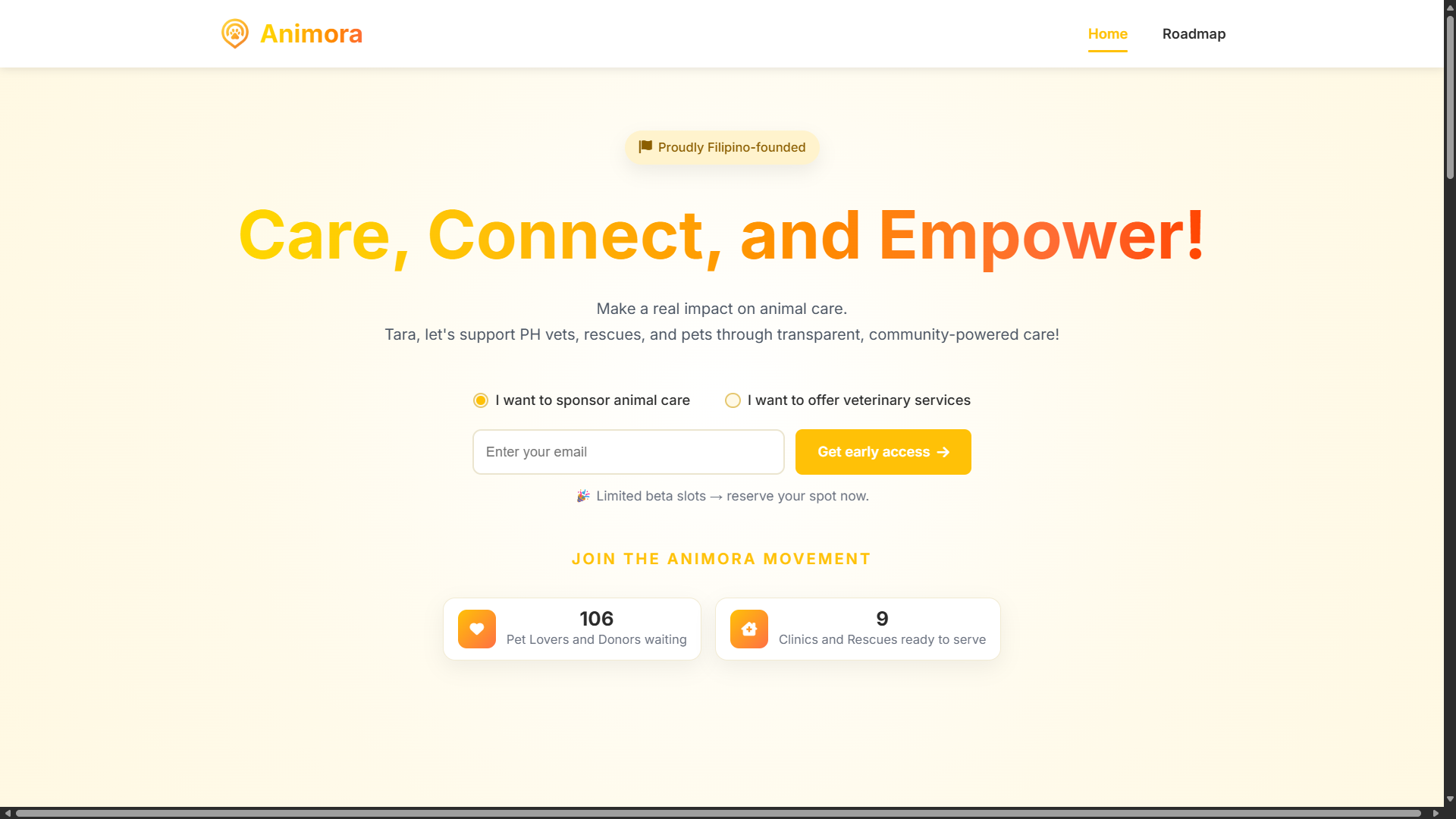
A warm yellow-to-orange palette, generous spacing, and a short headline give the page a welcoming tone. Home and Roadmap navigation keep the main introduction and future direction easy to find.
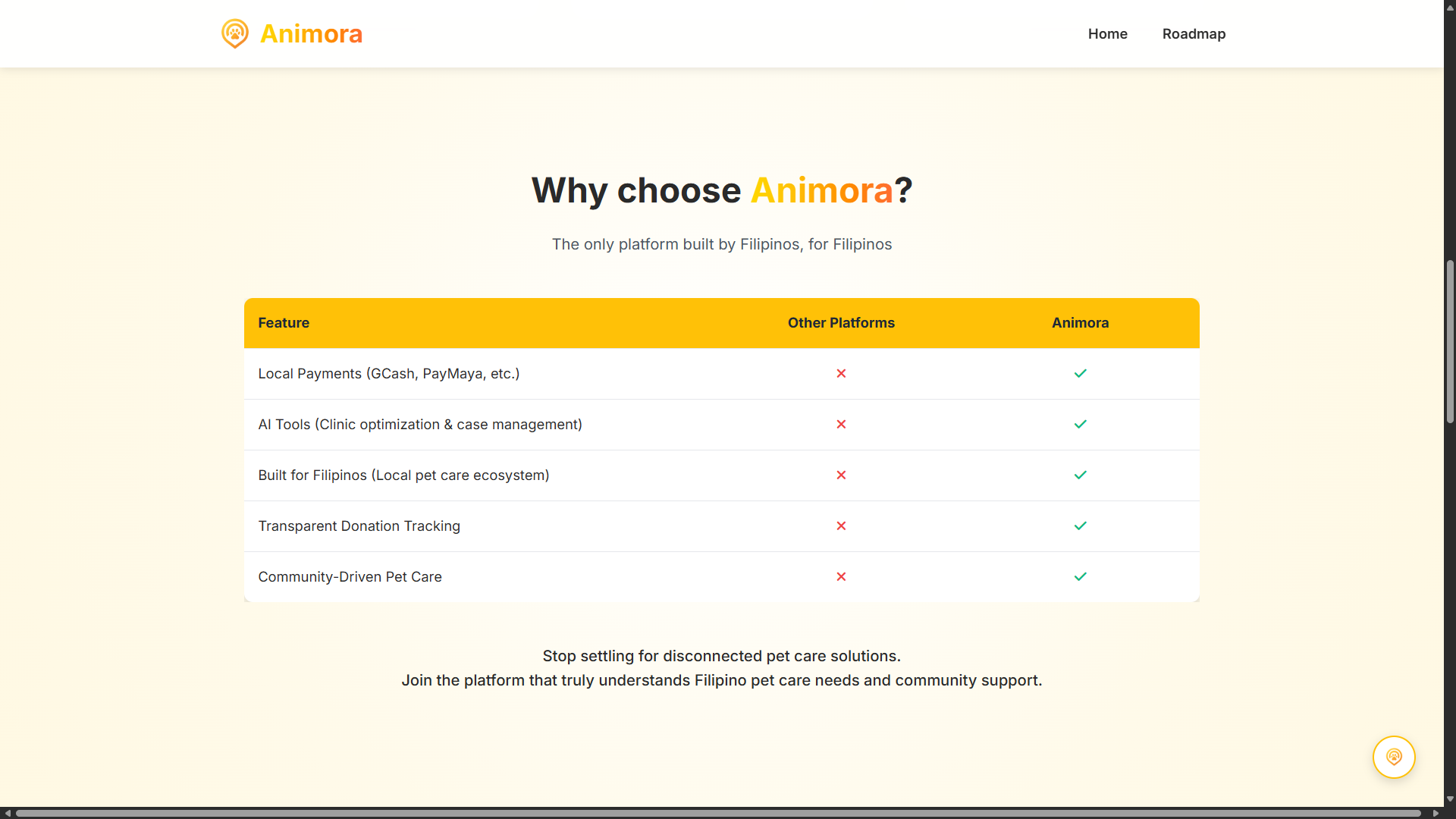
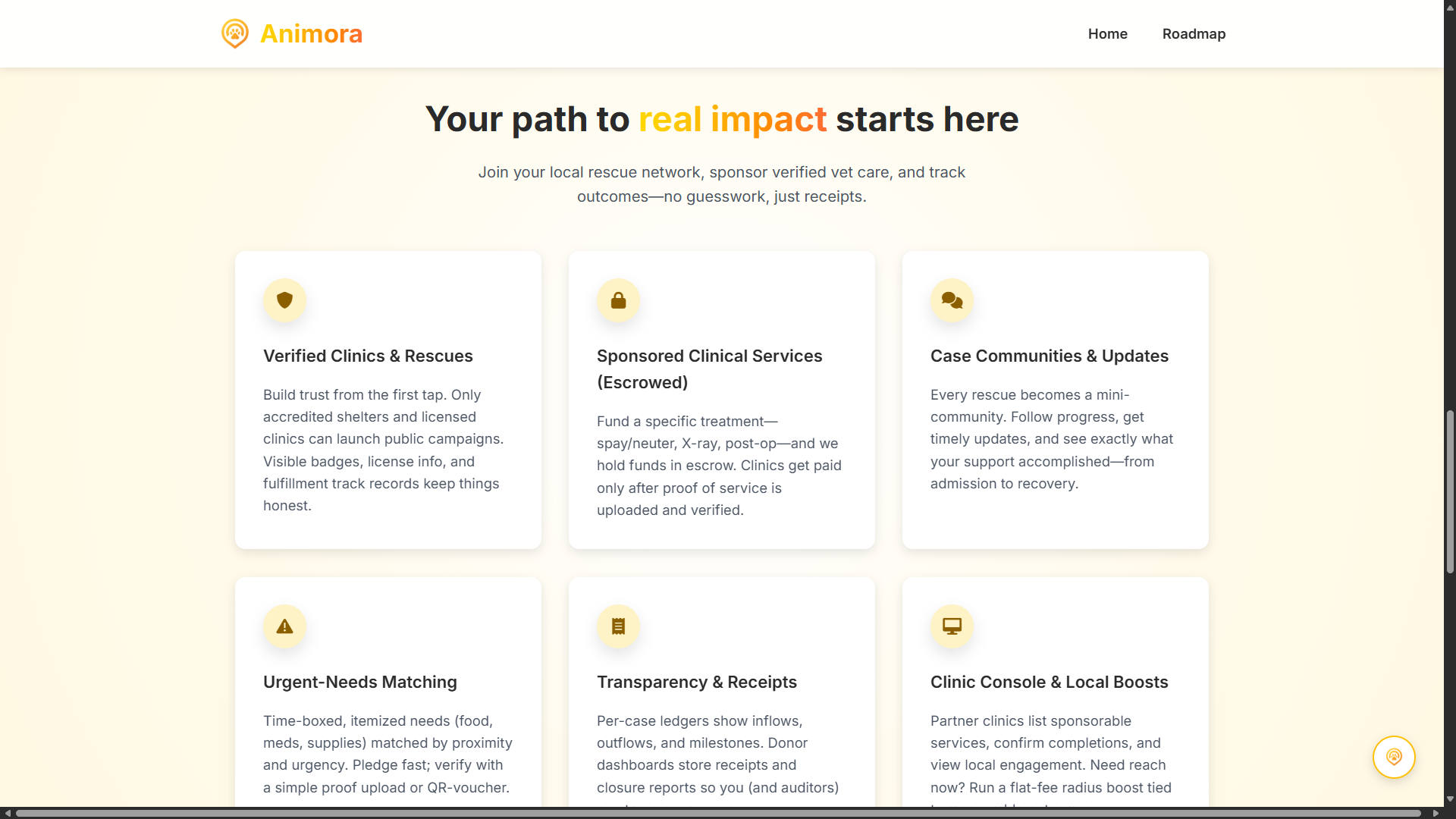
The feature comparison and benefit cards organize the proposed value into short explanations. Rather than reproducing the full business outline, the page emphasizes the themes most relevant to prospective participants: local animal care, verified partners, transparent support, and community updates.
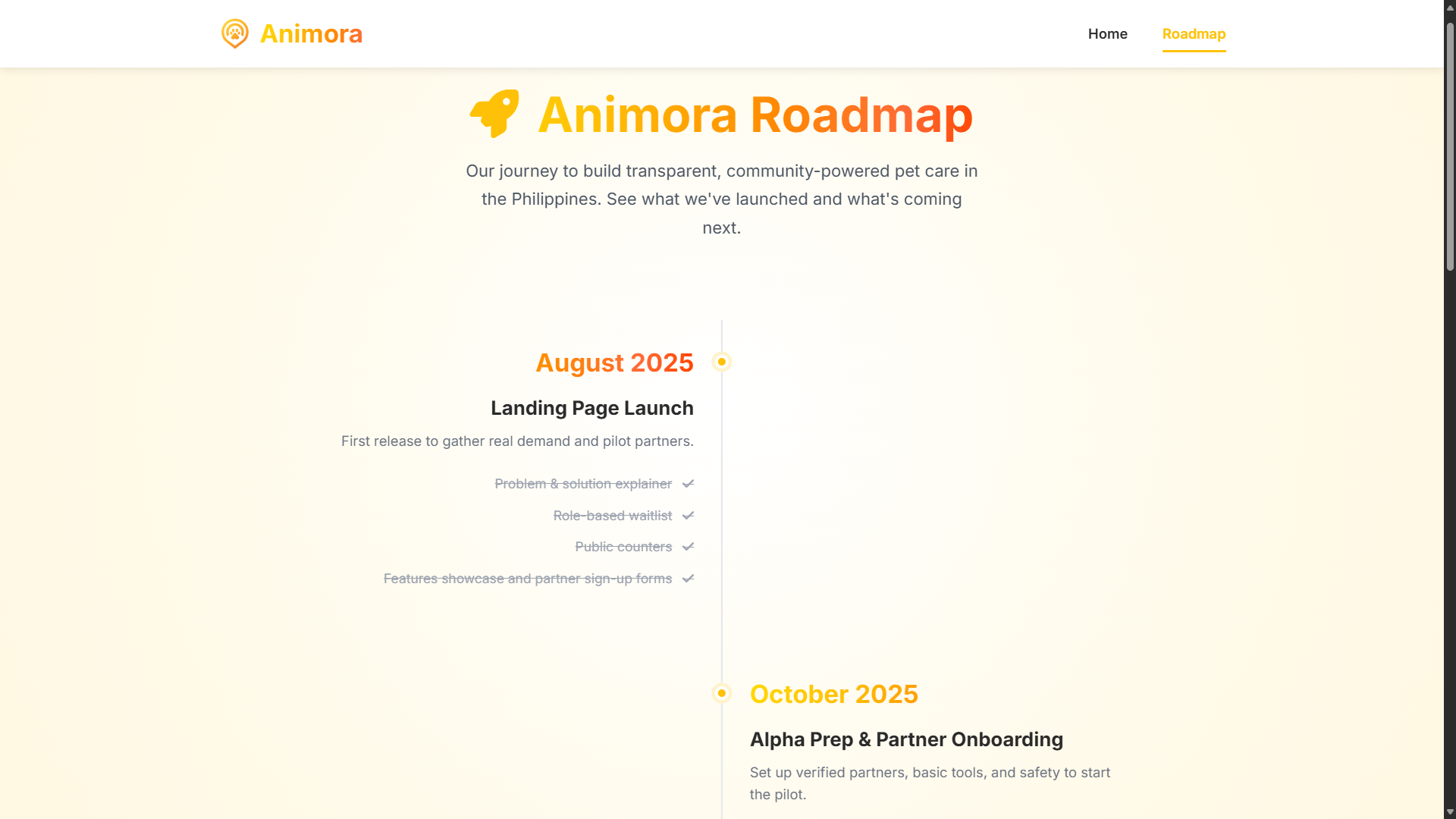
A separate timeline presents the landing-page release and subsequent plans for partner onboarding and platform development. It gives interested visitors context for what they are joining and how the concept is intended to progress.
The roadmap is a communication artifact from the pre-launch stage. Its dates and later milestones describe the plan shown on the page, rather than verified completion of the wider product.
My role was Team Lead for the entry. The focus of this deliverable was helping the team turn a broad platform proposal into a clear public introduction, with an immediate registration action and a visible product direction.
Veterinary bookings, payments, donation tracking, partner verification, rewards, and clinic tools belong to the proposed platform. Their appearance in the page’s marketing content is not evidence that these services were implemented in the landing-page release.
The screenshots document the page and its registration interface. They do not establish verified signup totals, partnerships, or animal-welfare outcomes. A next step would be to evaluate registration completion and learn which participant groups show interest before expanding the product.
A public React and Next.js landing page deployed on Vercel, with an early-access registration interface, a feature overview, and a roadmap. As Team Lead, I helped the team translate the startup concept into this pre-launch deliverable. The result is a place to introduce Animora and invite interest; it does not establish that the proposed animal-care services are operational.
PROJECT / 03
Client Project / Landing Page
A client landing-page project for Anytime Fitness, built with React, TypeScript, and Tailwind CSS. The page brings club discovery, membership information, and coaching into one experience, with a preview available while official utilization is still pending.
Design a landing page for Anytime Fitness that introduces the fitness experience and gives prospective members clear ways to find a club and explore membership. This was my first paid project, marking the move from academic work to a commissioned design deliverable. The page is available as a preview while official utilization remains pending.
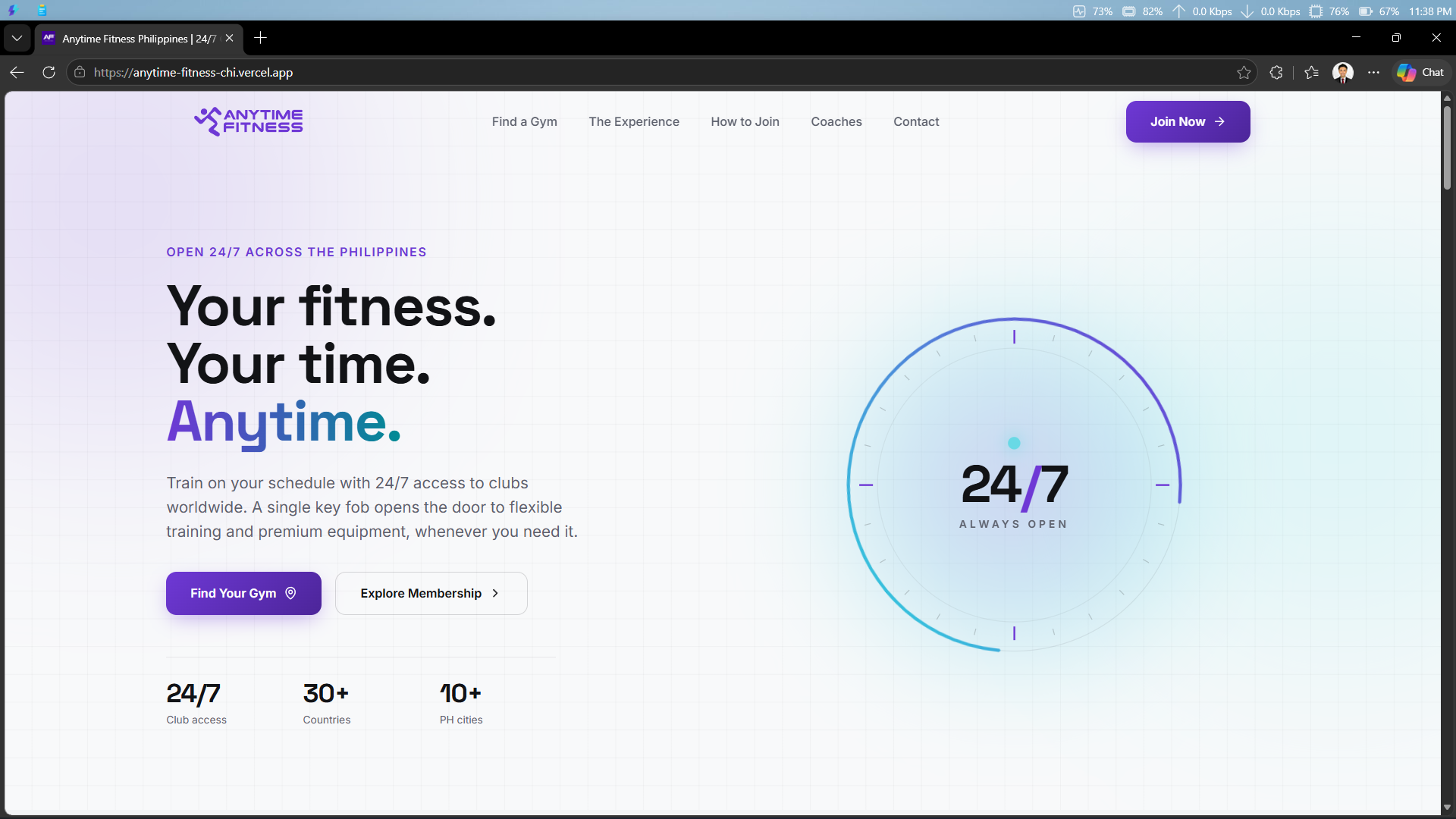
The opening section pairs a large typographic message with a clock-inspired 24/7 visual. Purple and aqua accents connect the brand presentation to the main actions: finding a gym and exploring membership.
A compact navigation bar gives visitors direct routes to the club finder, experience, joining information, coaches, and contact section. The hierarchy keeps those destinations visible without making the introduction compete with every detail below it.
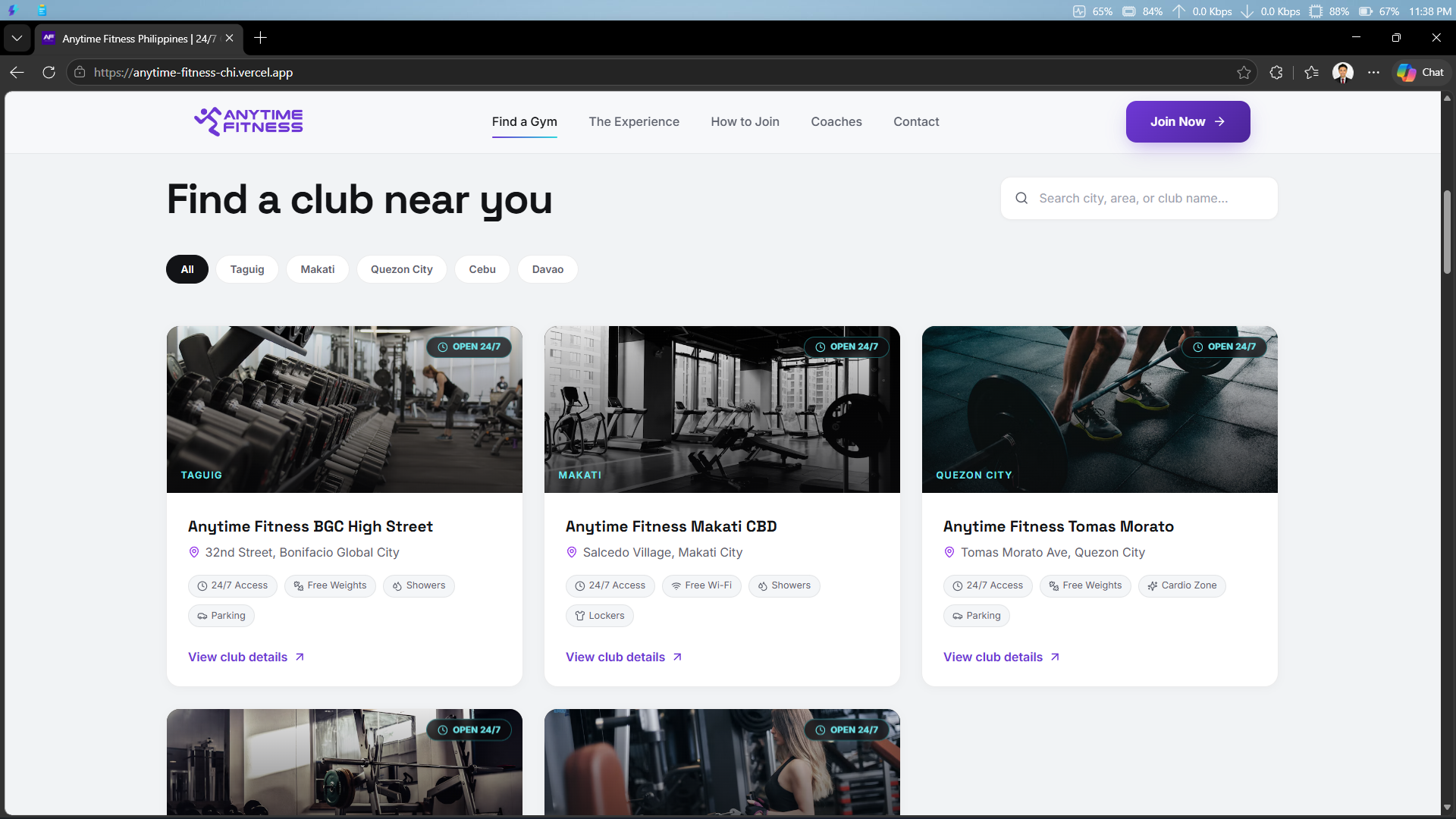
The club finder combines a search field with city filters and location cards. Each card groups a club name, location, amenities, and a details action, helping visitors compare options in a consistent format.
The implementation filters a local location dataset by city, club name, and area, then opens the selected club in a detail modal. This brings useful interaction to the landing-page design without presenting the preview as a live club-directory integration.
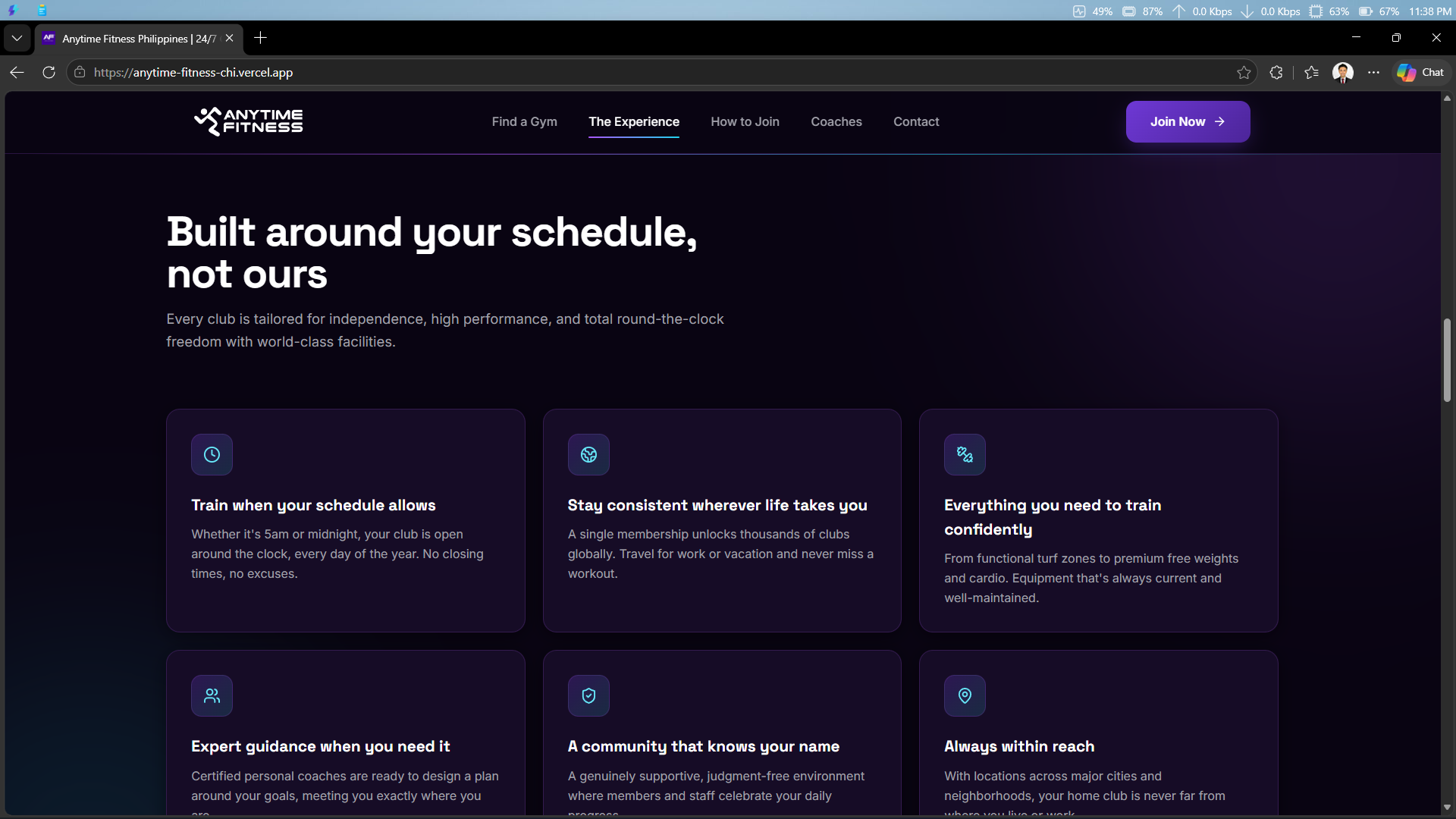
The experience section shifts into a dark visual chapter. A consistent set of cards organizes the benefits into short, scannable explanations, with icons and contrasting headings providing clear entry points.
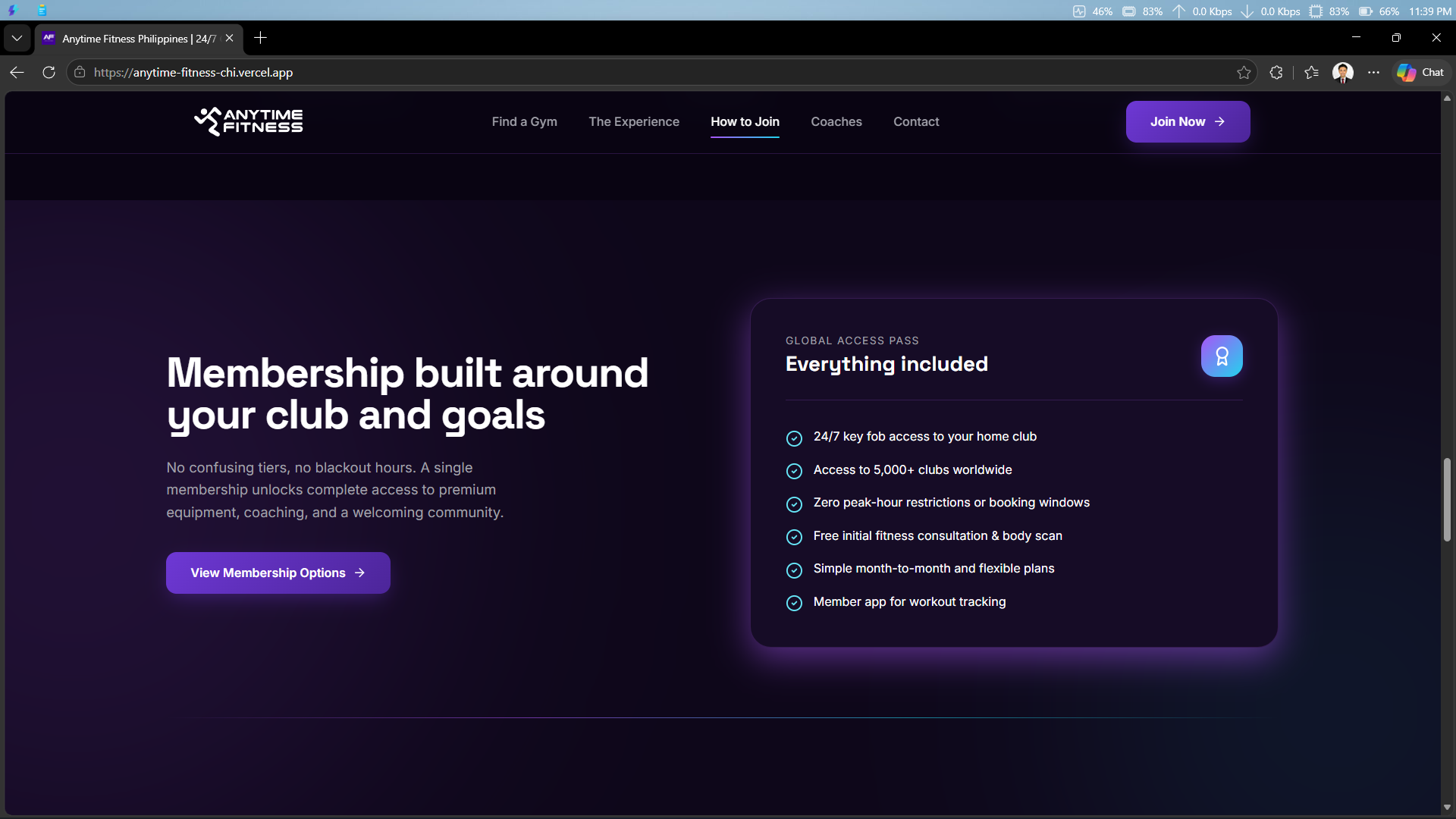
Membership information uses a two-column composition: an introduction and action on one side, with an included-benefits panel on the other. This separates the main message from supporting detail while keeping the next step nearby.
Coach cards use large photography, role labels, and names to introduce the coaching offer. The repository separates coach data access from the React components, with a mock provider as the default and a separate HRIS provider option.
React components divide the page into focused sections. TypeScript describes shared data, Tailwind CSS supports responsive layouts, Framer Motion supports animated presentation, and shared theme tokens coordinate the light and dark chapters.
As the landing-page designer, I shaped the visual direction, content hierarchy, and presentation of the visitor journey. The design brings club discovery, membership, and coaching into one consistent experience. The Vercel page remains available for viewing while its official utilization is pending.
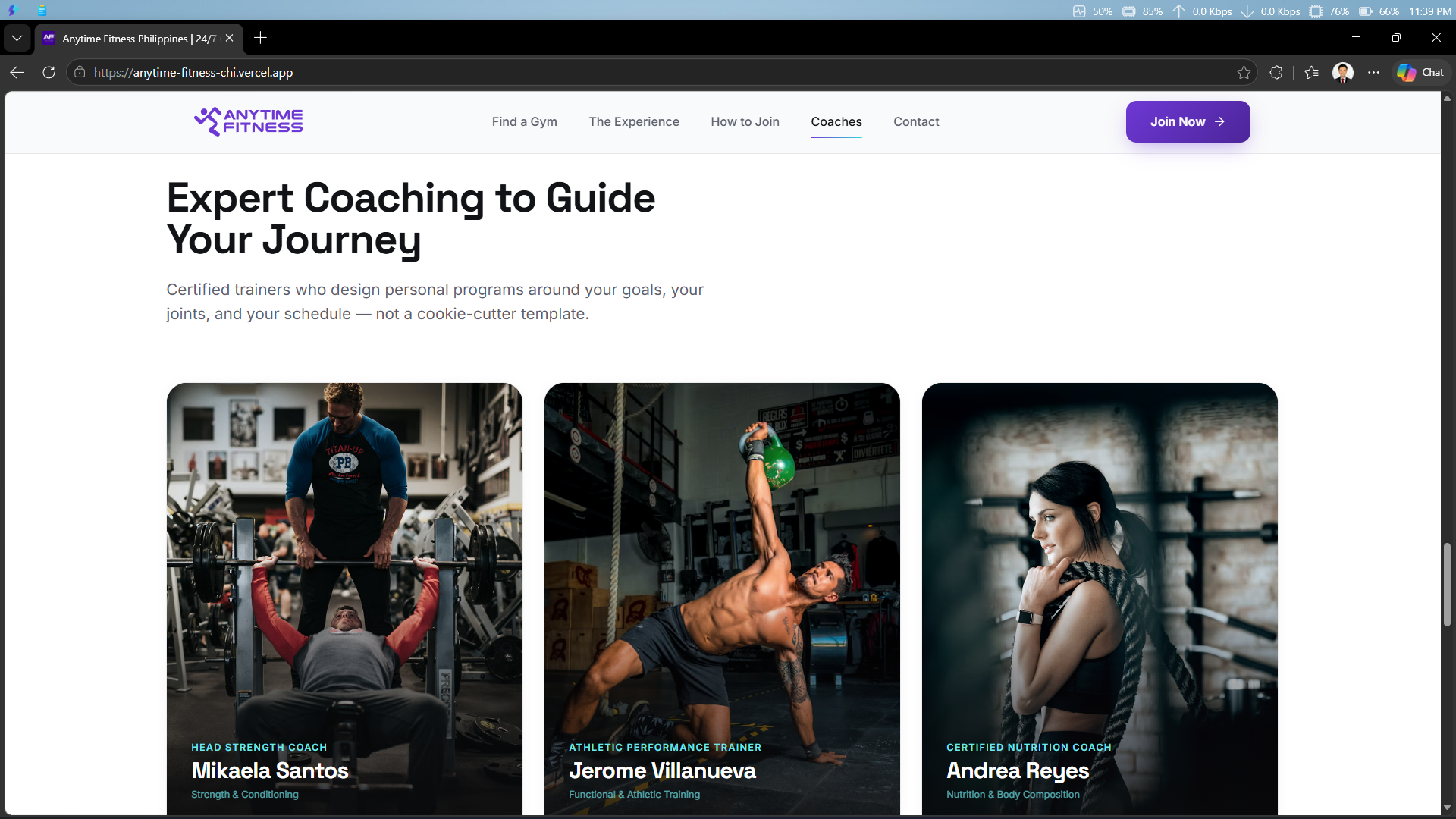
A client landing-page design with an accessible preview, covering the hero, club finder, fitness experience, membership, coaching, and contact sections. My role focused on the landing-page design and the presentation of its content and interactions. Official utilization is still pending; the preview represents the delivered design rather than a confirmed official launch.
PROJECT / 04
Community / Arcade Toolkit
Under development
An arcade-style digital literacy toolkit for Grades 4–6 learners, developed as part of PROJECT XP, the 2025 SIBOL ng Laguna Kaunlarang Teknolohikal champion initiative. Still under development, it brings learning games, facilitator resources, and community documentation into one platform.
Make digital literacy engaging and practical for Grades 4–6 learners in Cabuyao’s underserved communities. The Arcade Toolkit is the digital component of PROJECT XP: Experience Digital Growth in Laguna’s Arcade of Learning, a wider youth-led initiative by the Association of Computer Science Students at the University of Cabuyao. The toolkit remains under development.
PROJECT XP was submitted by the Association of Computer Science Students, University of Cabuyao, for Kaunlarang Teknolohikal under Gawad Kampeon para sa Kabataan ng Laguna — “SIBOL,” Kabataan para sa Magandang Laguna.
The wider PROJECT XP initiative became the first-ever champion of the Kaunlarang Teknolohikal category at SIBOL ng Laguna 2025. That recognition belongs to the whole initiative: its community learning model, youth leadership, and supporting activities. The Arcade Toolkit featured here is one component and is still under development.
The full initiative combines mentor preparation, pop-up learning arcades, hands-on activities, and support for parents and teachers. The platform gives that work a digital home and a foundation for making the learning experience reusable.
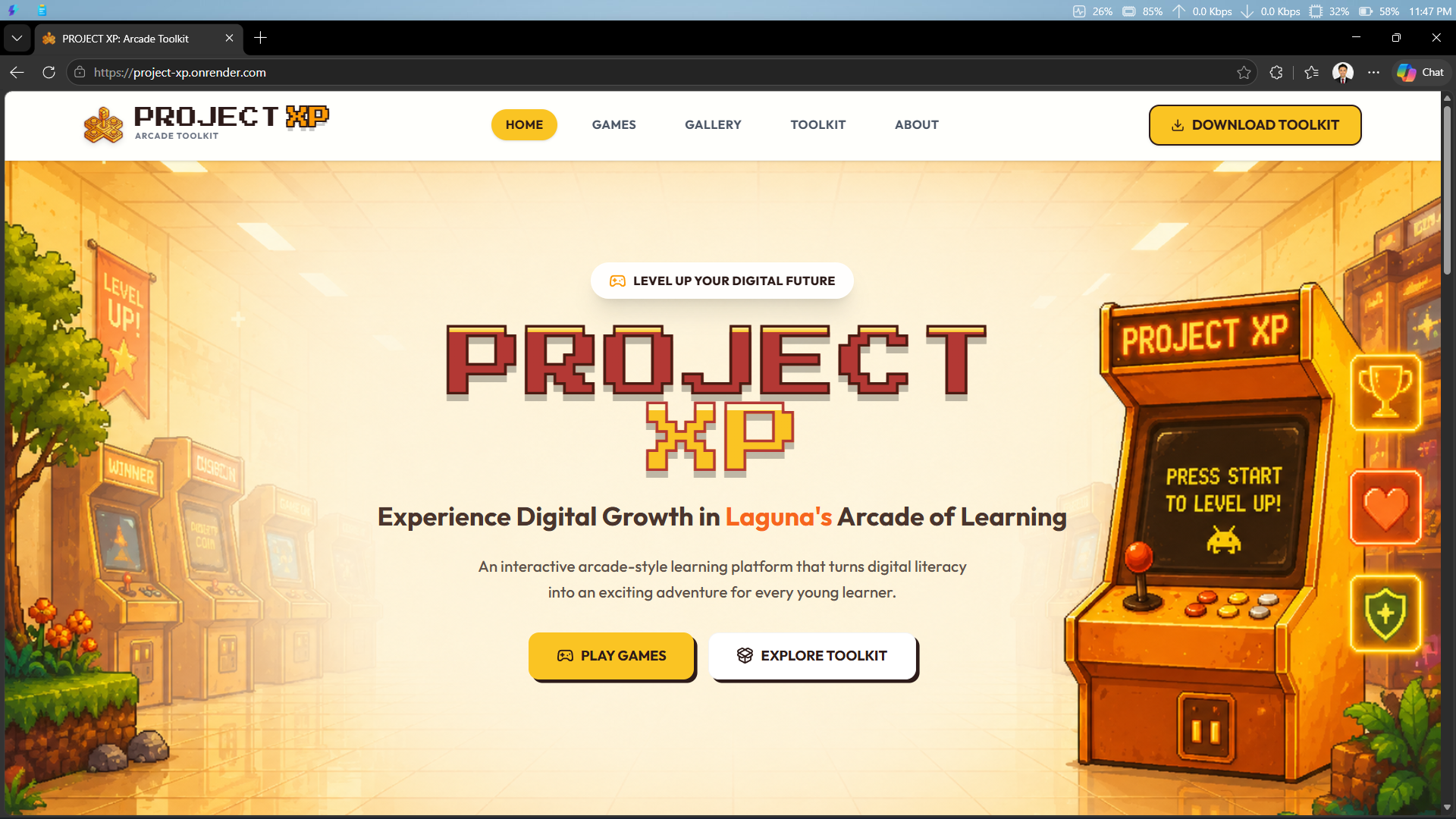
The home screen uses arcade imagery, pixel-style headings, and a warm yellow palette to frame learning as an adventure. Clear Play Games and Explore Toolkit actions give learners and facilitators different entry points.
Navigation separates Games, Gallery, Toolkit, and About. This structure connects the learning activities with their educational purpose, community setting, and the people behind the initiative. The current platform is a development preview, with further toolkit work still in progress.
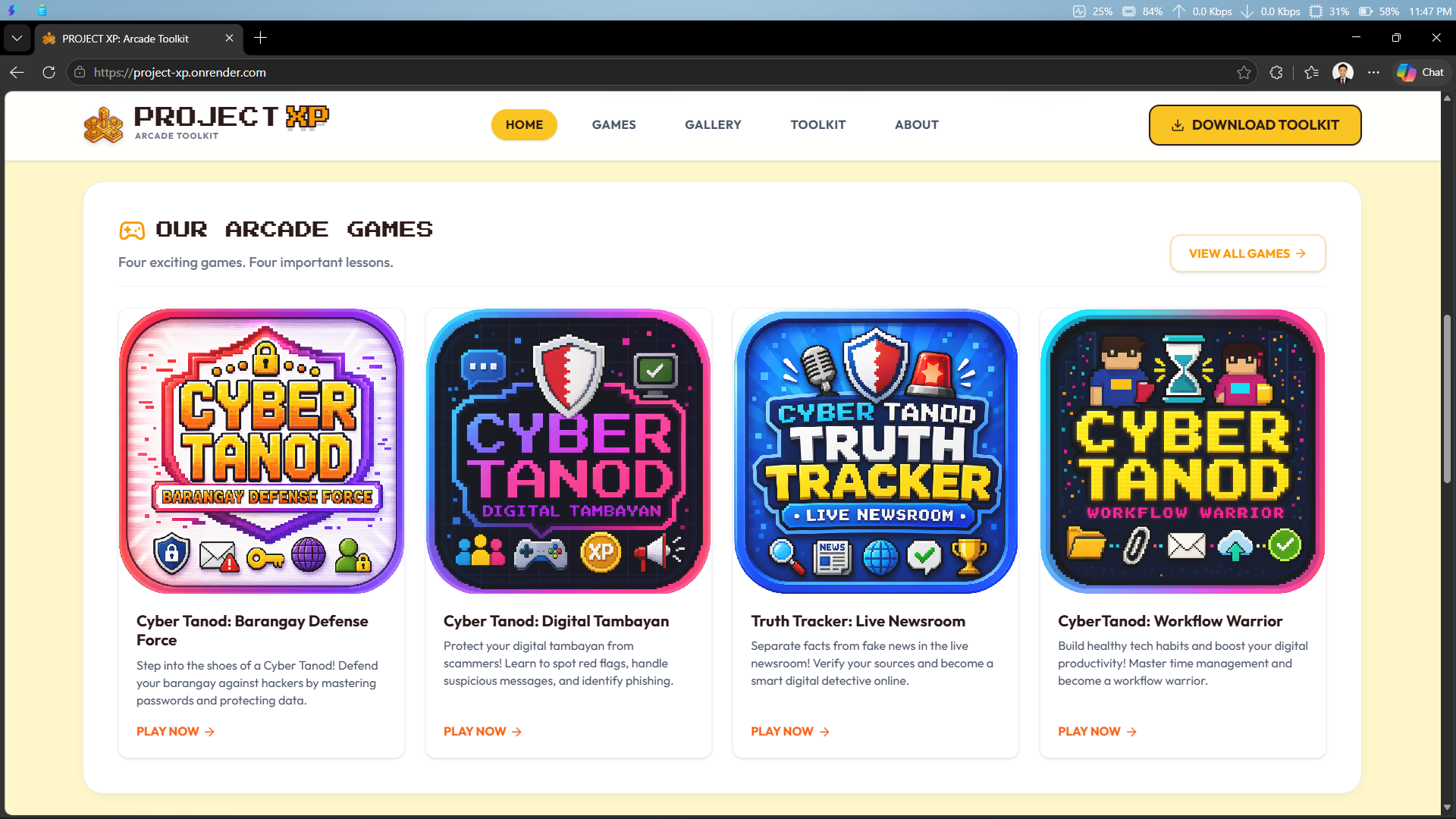
Cyber Tanod: Barangay Defense Force frames password safety and data protection around defending a barangay. It translates security concepts into a familiar local setting for young learners.
Cyber Tanod: Digital Tambayan introduces scam awareness, suspicious messages, and phishing red flags. Guided activities are intended to help pupils connect game choices to safer behavior online.
Truth Tracker: Live Newsroom focuses on checking sources and separating facts from misleading information. It reflects the wider initiative’s fact-checking and misinformation learning strand.
Cyber Tanod: Workflow Warrior introduces productive technology use and healthy digital habits. The broader learning plan includes file handling, documents, collaboration, and email practice, supported by youth mentors.
Grades 4–6 pupils are the primary beneficiaries. Parents and teachers help reinforce responsible digital habits outside the sessions, while barangay councils, Sangguniang Kabataan groups, and local partners support access and continuity.
The platform’s About page explains the initiative’s educational, youth-led, and not-for-profit character. Its impact gallery provides a place to document school visits and community activities, with filters for the locations shown in the preview.
The toolkit is intended to support facilitated learning rather than leave children to interpret every activity alone. Youth mentors connect the games to conversations about privacy, online behavior, checking information, and everyday technology use.
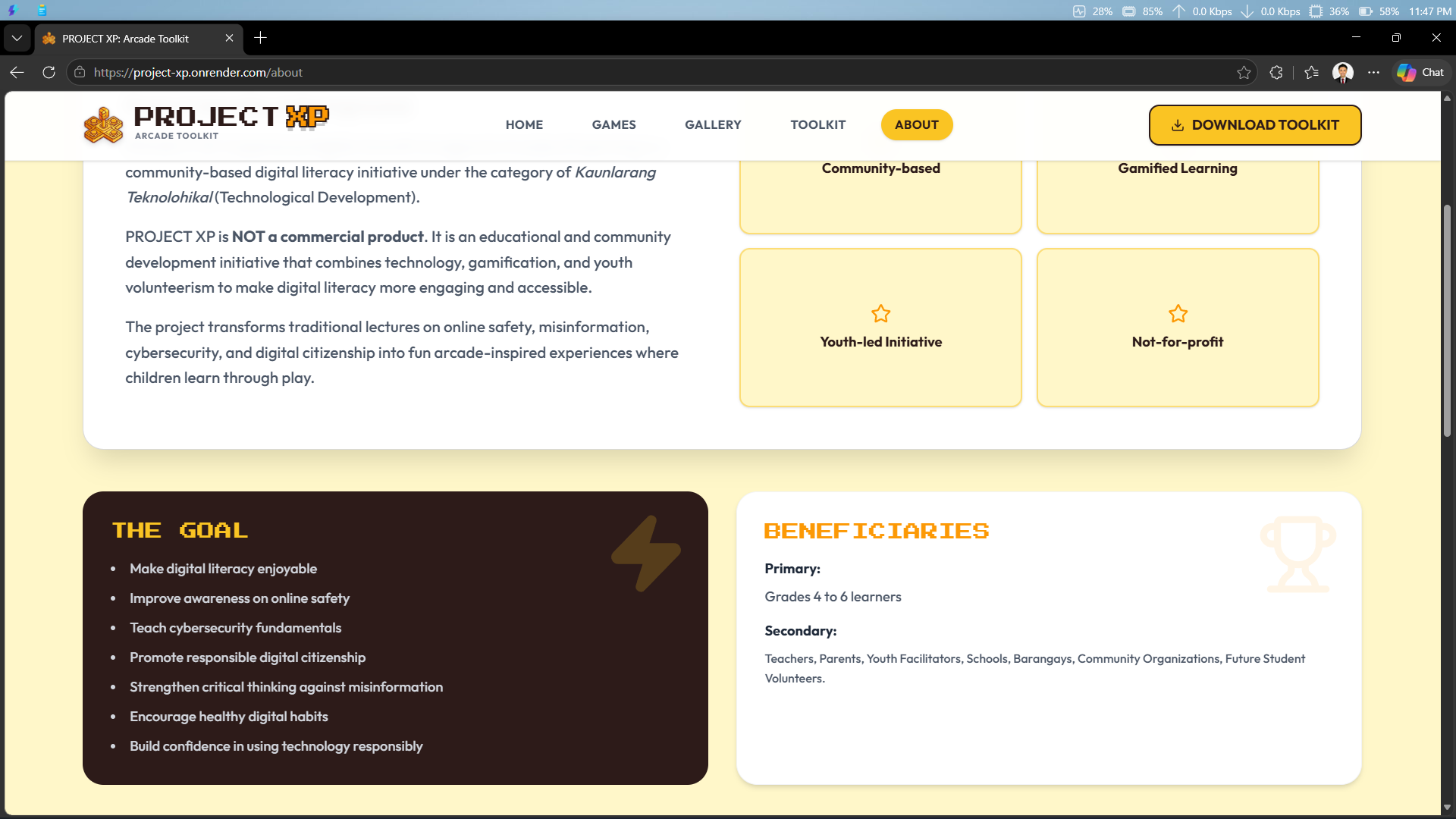
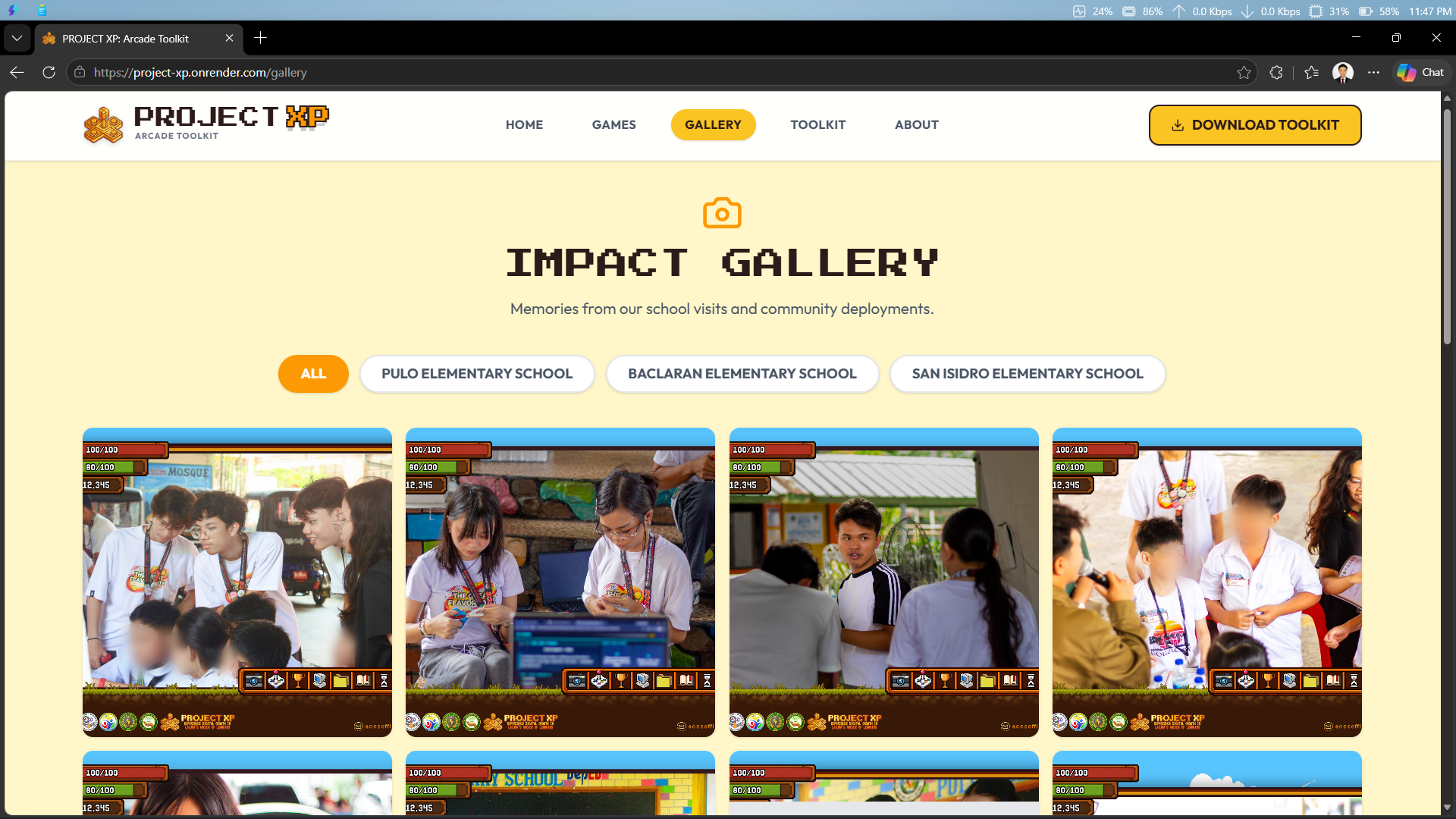
The Arcade Toolkit remains under development. The current preview demonstrates its visual direction, game catalogue, gallery, and project information; the complete reusable toolkit is an ongoing deliverable.
The initiative’s original plan targeted 30–40 youth mentors, four barangay pop-up arcades reaching 280–320 pupils, and around 100 parents and teachers through supporting clinics. These are program targets, not measured outcomes attributed to this platform.
The plan set a target of at least 30% improvement in digital-literacy test scores. Assessment rubrics and guided activities are intended to make learning progress observable; that target is not presented as an achieved result.
The intended open-source toolkit brings together lesson cards, game scripts, and assessment rubrics for local adaptation by CESD, barangays, and SK councils. The wider proposal aligns with SDGs 4, 16, and 17 through education, informed participation, and partnerships.
The Association of Computer Science Students at the University of Cabuyao leads the wider initiative. These responsibilities describe the project proponents’ work across PROJECT XP, including the direction and support needed for the Arcade Toolkit.
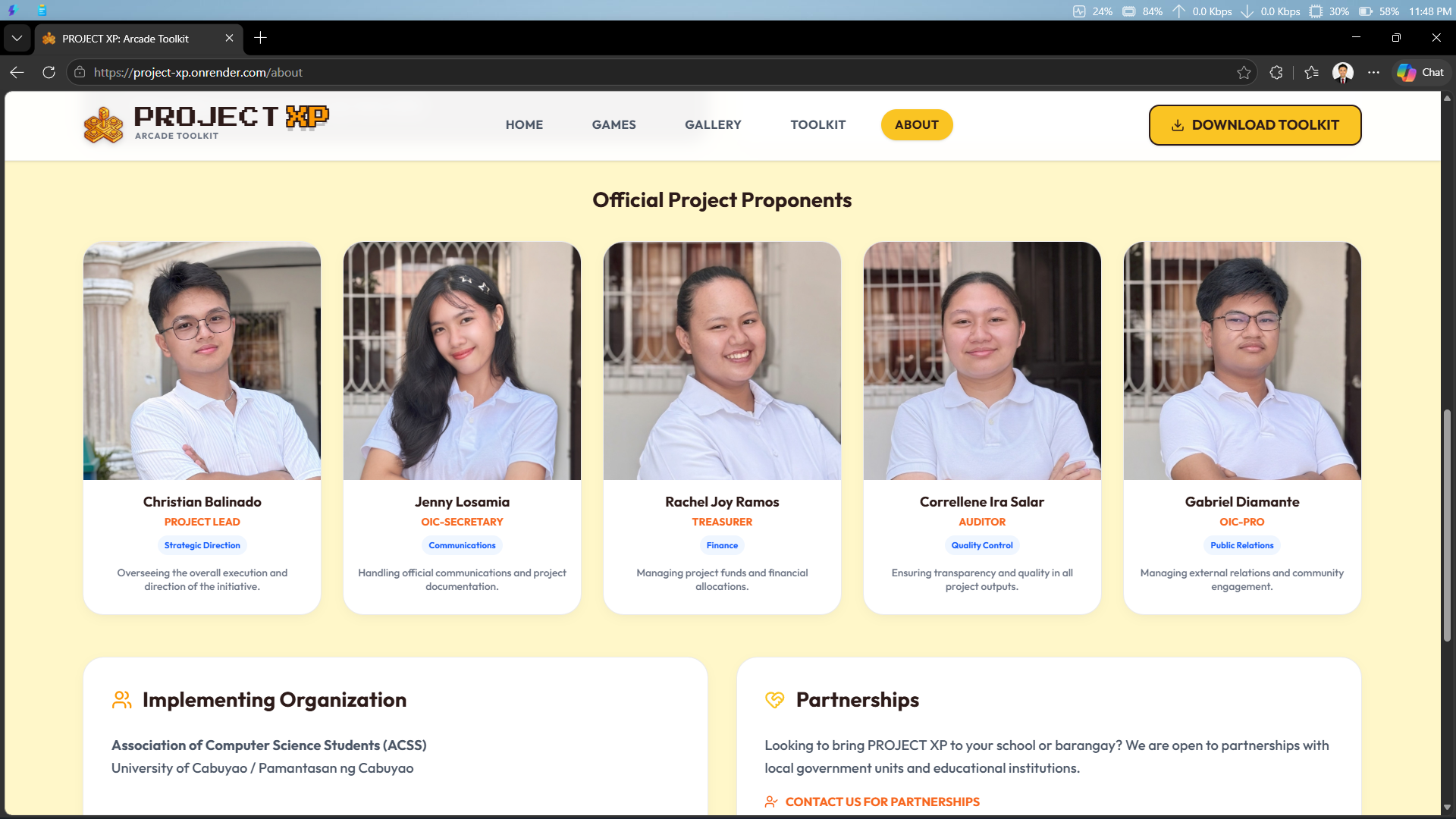
Overseeing the overall execution and direction of the initiative.
Handling official communications and project documentation.
Managing project funds and financial allocations.
Ensuring transparency and quality in all project outputs.
Managing external relations and community engagement.
An Arcade Toolkit platform under active development, with a game catalogue, project information, and community gallery shown in the current preview. It supports the wider PROJECT XP initiative rather than representing the entire program. My role is Project Lead for the initiative, overseeing its overall execution and strategic direction.
PROJECT / 05
Course Project / Desktop LMS
Our second-year OOP final project: a Java Swing learning management system for students, instructors, and administrators. NovaLearn connects courses, learning content, notifications, and performance tracking through object-oriented design, using Singleton, Factory, and Observer patterns with in-memory object lists.
Build a Java desktop learning management system that connects student learning, instructor workflows, and account administration. NovaLearn was our second-year Object-Oriented Programming final project: an opportunity to turn classes, relationships, and design patterns into a usable multi-form Swing application.
The entry screen separates Student, Instructor, and Admin login paths. This makes the available workflows clear before users enter the application and supports distinct responsibilities throughout the design.
The UML places shared account information in User, with Student, Instructor, and Admin representing specialized roles. AccountManager centralizes account collections, account selection, and logout, giving the different forms a shared view of the active session.

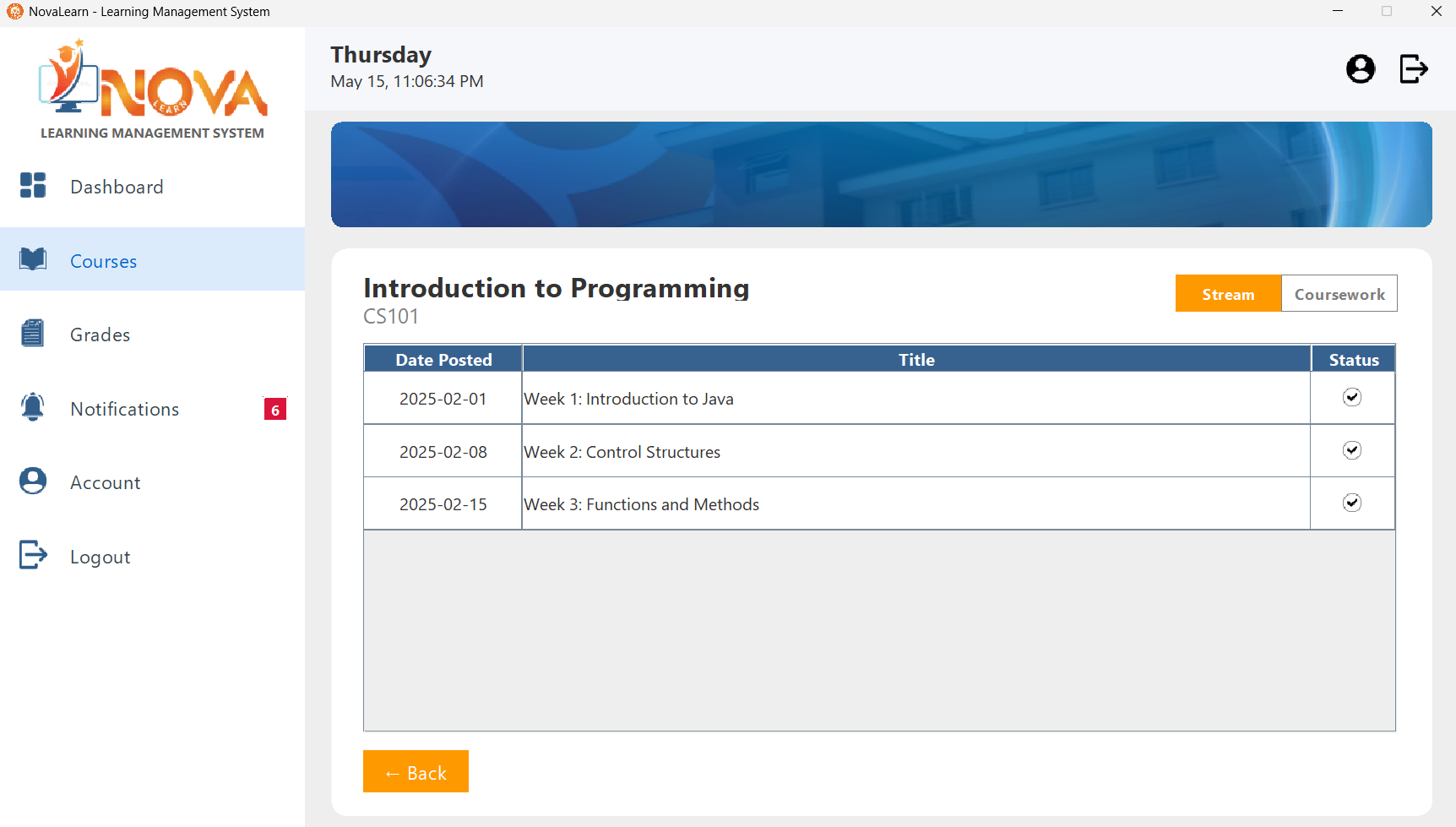
The student interface brings Courses, Grades, Notifications, and Account into a consistent sidebar. The course stream shows dated learning materials and completion indicators, while Stream and Coursework tabs separate learning content from activity work.
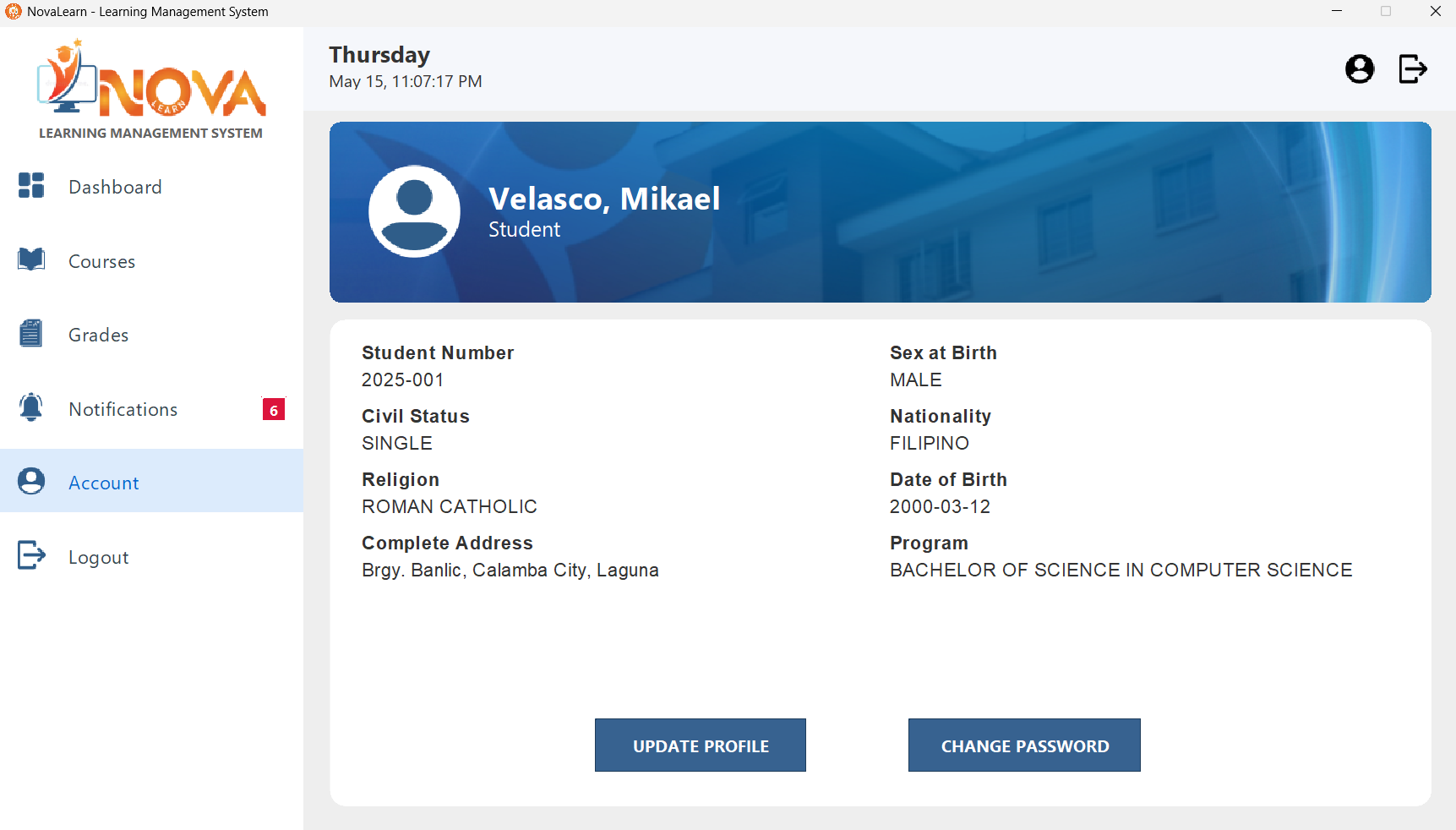
Profile management gives students a dedicated account view with update-profile and change-password actions. In the object model, Student owns profile data and keeps collections for enrolled courses, grades, and notifications. Course enrollment and activity submission are modeled as domain actions rather than database operations.
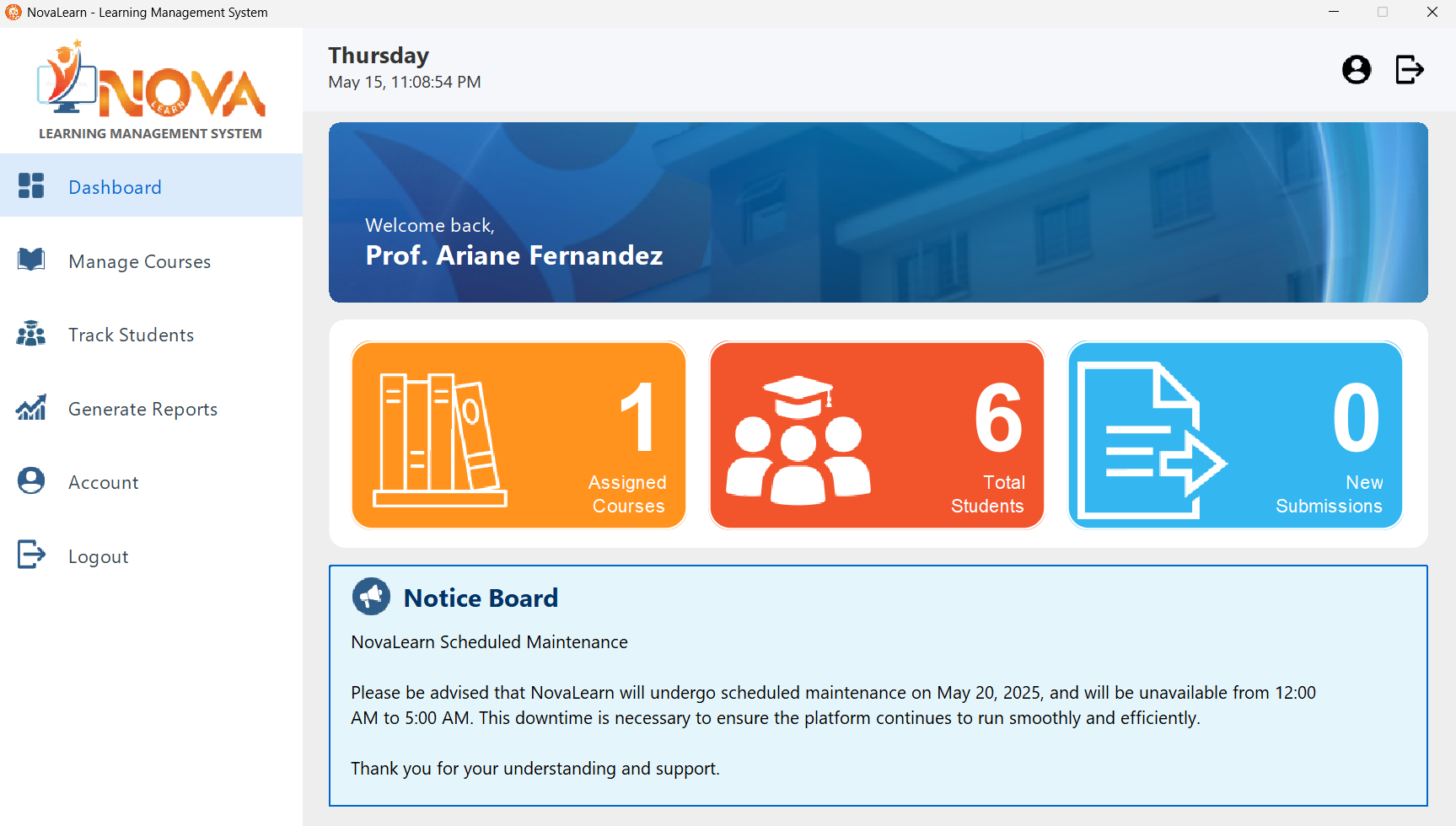
The instructor dashboard summarizes assigned courses, total students, and new submissions. A notice board provides a visible place for shared announcements, while the sidebar leads to course management, student tracking, reports, and account settings.
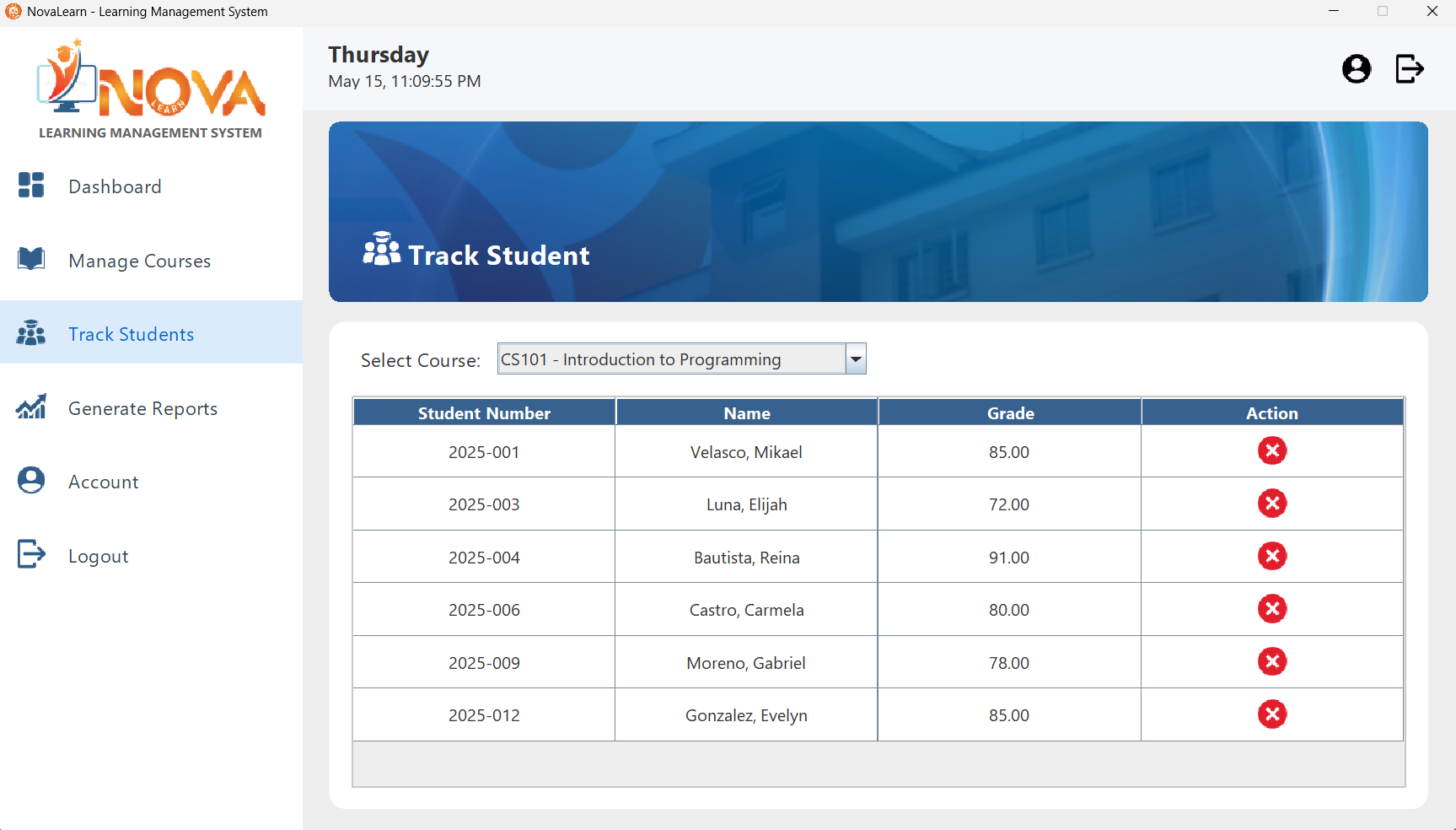
The tracking screen filters students by course and presents student numbers, names, grades, and an action column. The UML extends this workflow with instructor methods for posting content, uploading grades, retrieving student tables, and generating course-specific reports.
For the administrative side, the design assigns Admin responsibility for creating student and instructor accounts, creating courses, assigning instructors, deleting records, and removing students from courses. This connects the CRUD requirement to explicit domain operations.
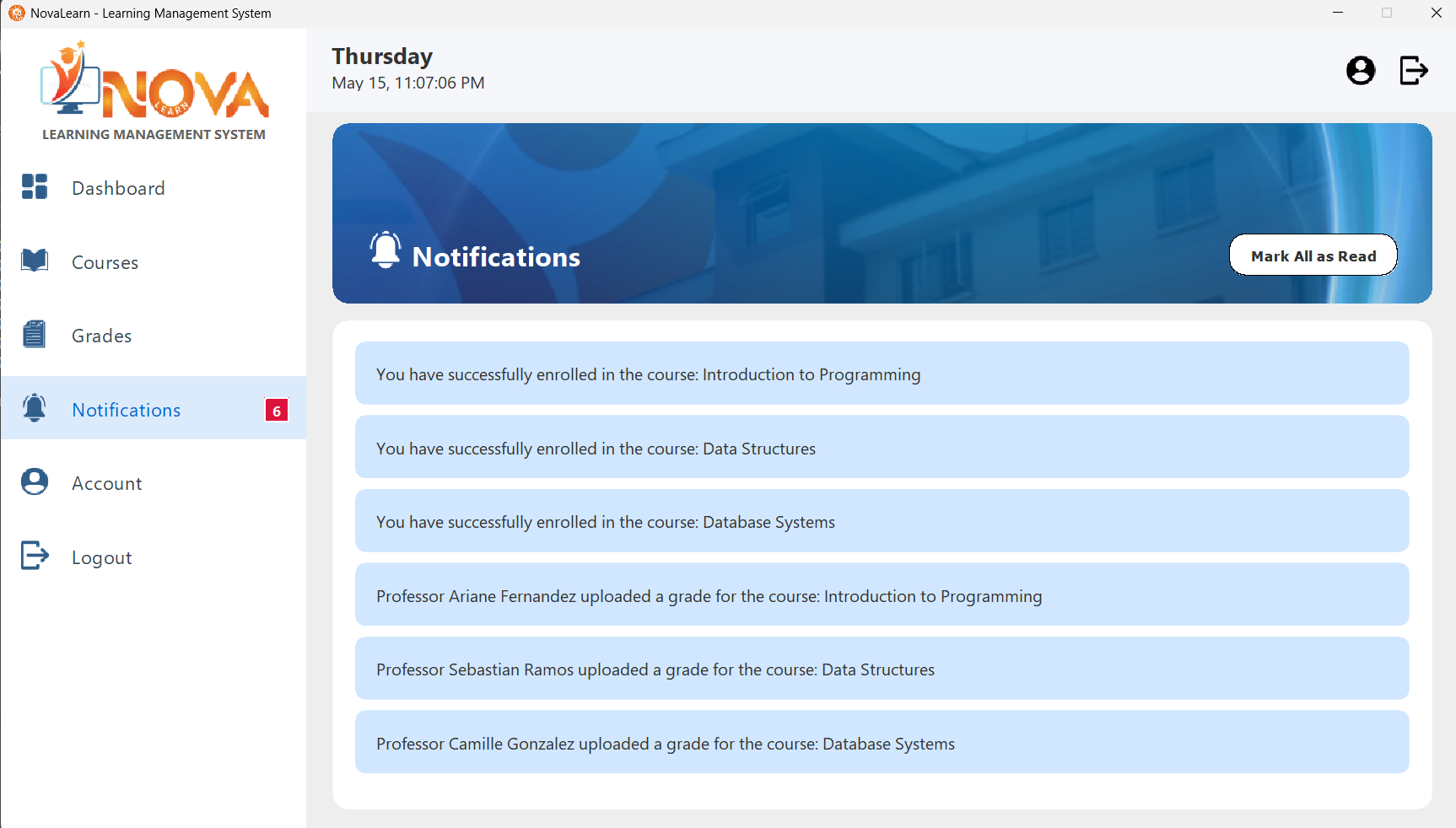
The notification screen shows enrollment confirmations and grade-update messages, an unread count, and a Mark All as Read action. The design uses NotificationService and NotificationListener to connect changes in application state to student-facing updates.
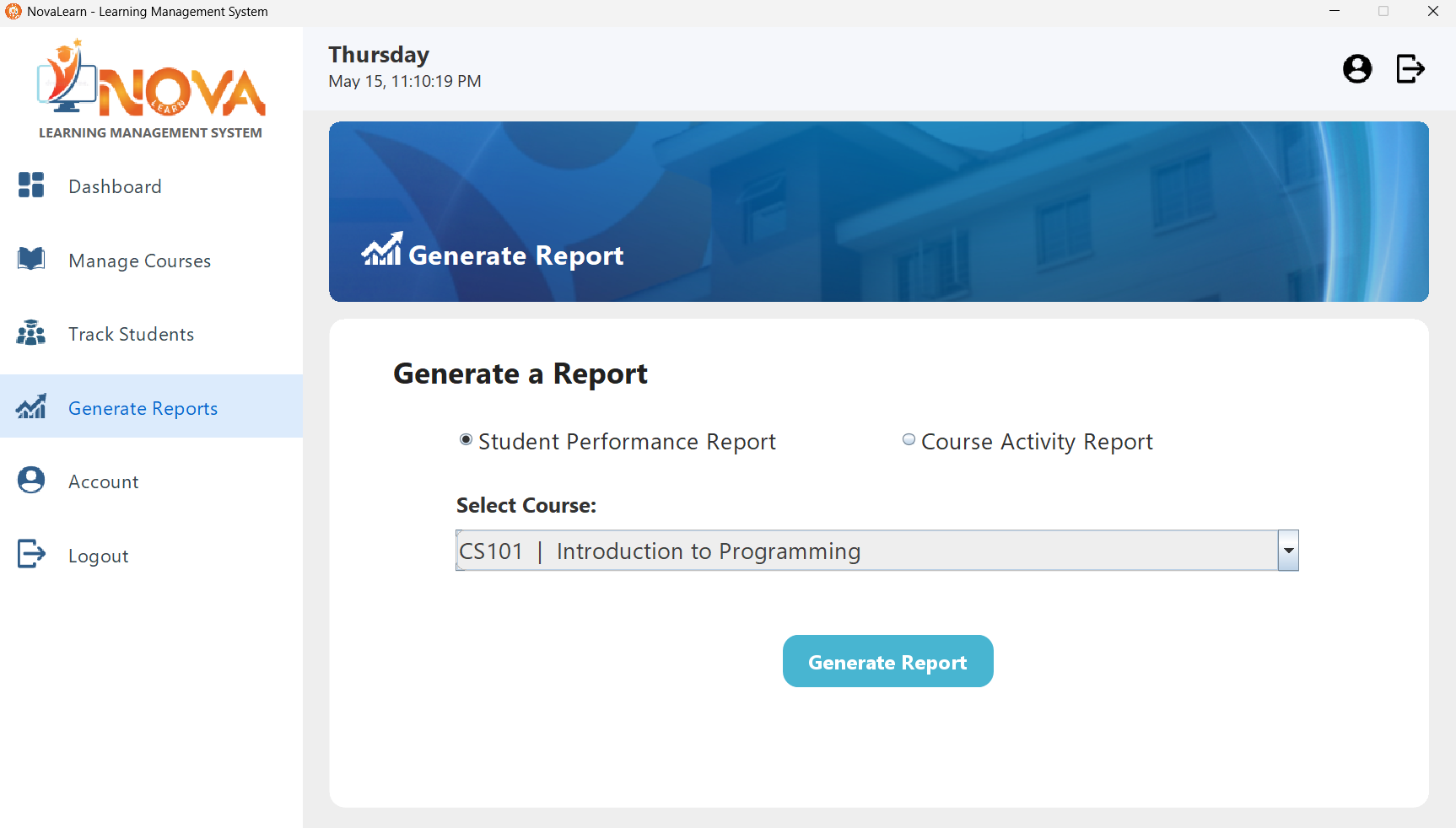
The instructor report screen offers Student Performance Report and Course Activity Report options with a course selector. The UML also defines a ReportService for student, instructor, and course reports, and separates report generation from the screen that requests it.
Enrollment, grade updates, and activity submissions are the learning transactions represented in the model. Each connects a user action to changes in the relevant course, student, activity, or notification objects.
CourseManager has a shared instance and a List of courses. AccountManager similarly centralizes user collections and the active account. These managers give the desktop forms a common source of application state within the running session.
ContentFactory defines creation methods for Content and Activity. Keeping construction behind a factory separates the form collecting input from the domain objects it creates. Video, Document, and Quiz were the content categories specified by the course brief; the supplied screens do not independently demonstrate every category.
NotificationService keeps notification listeners and exposes notifyListeners(), while Student responds to notification updates. This gives the Observer requirement a concrete purpose: keeping the learning interface informed when relevant events occur.
Student-to-Course enrollment expresses association. Course collections of Content and Activity support the course-content aggregation model. Student and its profile illustrate composition, while the User hierarchy captures shared account identity with specialized behavior.
Loading diagram…
I led the overall group project and handled quality assurance, coordinating delivery and checking that the LMS experience addressed the assignment requirements. The work we built connects role-based entry, a course stream, account management, an instructor dashboard, student tracking, notifications, and report selection. My focus was the coherence and quality of that complete experience across the team’s work.
Using in-memory object lists made relationships and state changes central to the exercise. An enrollment, notification, grade, or content update had to be represented consistently across the relevant objects and screens without relying on a database to coordinate them.
NovaLearn was a classroom desktop prototype using demonstration data held in memory. Its value as a second-year project was the practical integration of GUI programming, OOP, and reusable design patterns, with leadership and quality assurance connecting the team’s individual work into a coherent deliverable.
A group-built Java Swing LMS prototype that brings course access, student profiles, instructor tracking, notifications, and report selection into one desktop experience. As Overall Project Lead with responsibility for Quality Assurance, I coordinated the group effort and helped keep the application aligned with the course requirements. The project demonstrates the transition from classroom OOP concepts to a connected application.